How-to guides · 8 min read
Trailering a Golf Cart: Ramps, Tie-Downs and Towing Tips
How to load, strap and tow a golf cart safely: trailer size, ramp length, tie-down points, weight checks and the mistakes that cause damage.
By the Buggies For Sale team · Updated
Moving a golf cart is easy once you have the right trailer, ramps and straps, and it can go badly wrong when you do not. This guide explains how to choose a trailer, how to load a cart safely, where to put the tie-downs, and what to check before you tow it. It is written for owners moving a cart between properties, to a workshop or to a new home.
Check the weight first
Golf carts are heavier than they look. A lithium cart weighs less than a lead-acid cart, and a four-seater weighs more than a two-seater. Find the kerb weight in the manufacturer's specification, then add anything on board. Your trailer's rated capacity, your tow vehicle's towing limit and your licence conditions must all allow the total. Always follow the tow vehicle manual and the road rules in your state.
Choose the right trailer
- Size: the deck must be long and wide enough for the cart, with room to walk around it. Check wheelbase and track width.
- Capacity: pick a trailer rated above the cart weight, not just equal to it.
- Brakes: heavier loads may require braked trailers. Check state requirements and your trailer's rating.
- Deck type: a flat or tilt deck is easier than a deck with wheel wells that clash with the cart tyres.
- Lights and registration: the trailer needs working lights and current registration for road use.
Ramps
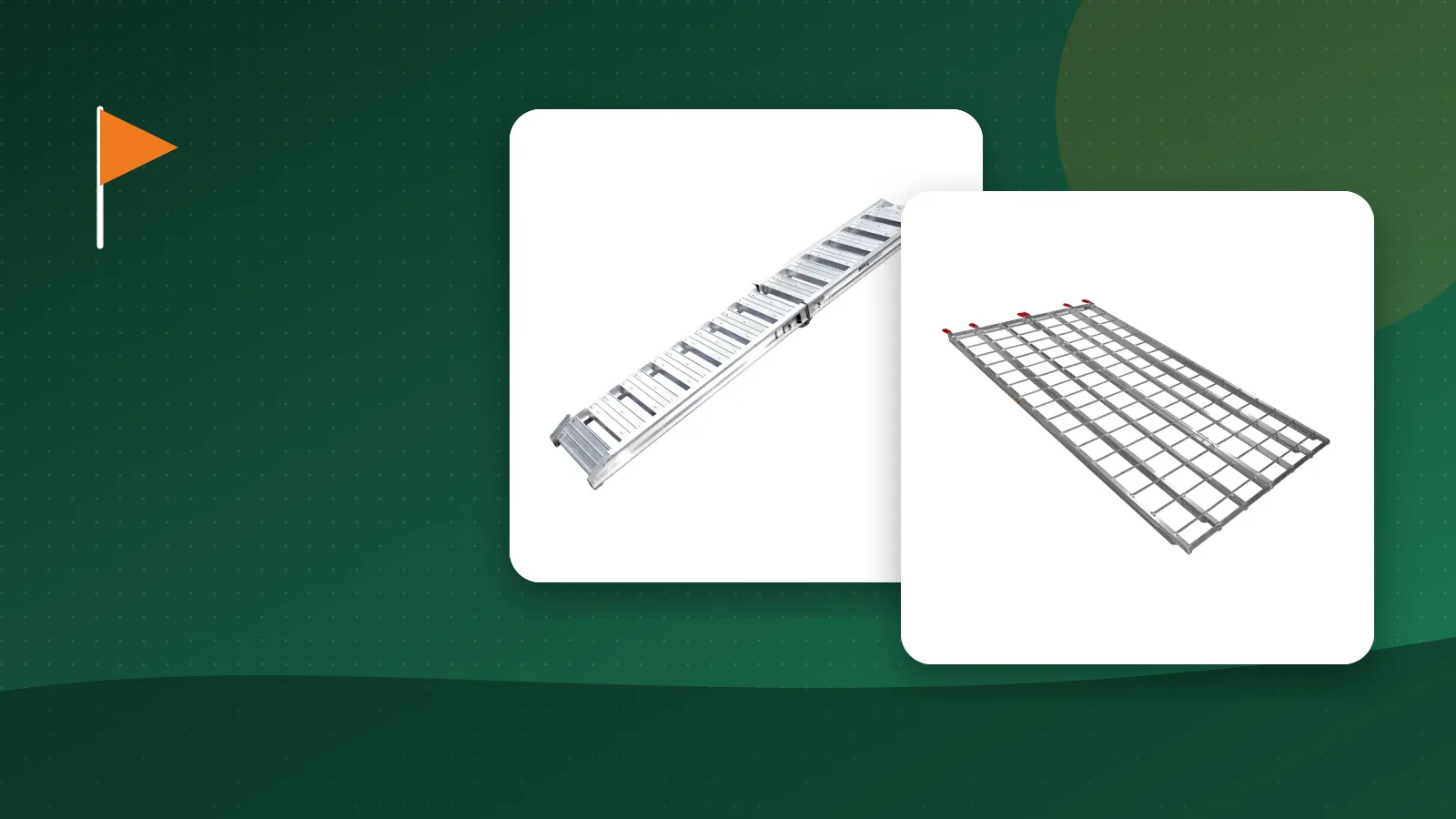
A long, shallow ramp is safer than a short, steep one. Ramps must be rated for the load, wide enough for the tyres and secured to the trailer so they cannot slip. Folding aluminium ramps are light and easy to store. We stock loading ramps suitable for ATVs and light vehicles. Check that the rated capacity covers the cart weight.

Loading step by step
1. Park the trailer on level ground, hitched to the tow vehicle, with the handbrake on.
2. Fit and secure the ramps. Make sure they sit flat on the ground.
3. Put the cart in low gear or the forward setting, and drive up slowly in a straight line. Do not stop on the ramp.
4. Place the cart so that weight sits slightly forward of the trailer axle, giving good tongue weight.
5. Apply the park brake, switch off the cart and remove the key.
Tie-downs
Use four ratchet straps rated for the load, attached to solid points on the cart frame or axles. Cross the straps if you can. Do not strap over plastic body panels, seats or roof. Avoid compressing the suspension fully, but keep the straps firm. After a few kilometres, stop and re-check tension. If the cart has a roof or canopy, check that it clears bridges and branches.
Towing tips
- Drive slower than normal and allow longer braking distances.
- Take corners wide and avoid sudden steering movements.
- Check mirrors regularly for sway.
- Plan your route to avoid steep driveways that can ground the ramps.
Protect the cart
Remove or secure loose items like bag racks, cooler boxes and umbrellas. If the cart has a lithium battery, check the battery is fixed, and disconnect it if the manufacturer recommends it for transport. Our guide to lithium vs lead-acid batteries explains the differences in handling.
Safety and the law
Overloaded or poorly secured loads cause accidents. If you are unsure about rules for trailers, braking and loads, check your state transport authority. Safe Work Australia also publishes general guidance on safe loading and vehicle use for workplaces, which is helpful if you move carts as part of a business.
Delivery option
If you would rather not move a cart yourself, we arrange freight to metro and regional Australia. See our golf carts for sale and used golf carts pages. Call 0420 128 746 for a freight quote.
Types of trailer and when to use them
A flat deck trailer is the simplest option and works with ramps. A tilt trailer lets the deck tilt so you can drive on without ramps. A box or enclosed trailer protects the cart from weather and theft, but it is heavier and costs more. For occasional moves, hiring a trailer may make sense. For regular use, a purpose-built tilt or beavertail trailer can save time. Check your car's tow rating and the trailer's weight limit, and make sure the cart fits with room for straps.
Ramp safety
Ramps are a common source of accidents. Always use ramps that are rated for more than the cart's weight. Make sure they are long enough to give a gentle slope and wide enough for the tyres. Fit them securely with locking pins or straps so they cannot slide. Keep the surface clean and dry, and avoid loading on wet grass. Never stand behind a cart on a ramp, and do not let anyone stand beside the ramp when you drive on.
Driving onto the trailer
Approach the ramps squarely and in a straight line. Use steady throttle rather than stopping and starting. Keep your head up and look at the trailer, not at your feet. If the cart is electric, use the lowest speed setting. Once on the deck, stop with the park brake applied, turn the cart off and remove the key. Have a helper guide you if possible.
Securing the cart
Use four tie-down points, placing them as close as possible to the wheels or frame. Ratchet straps are easy to tighten and release. Avoid straps over body panels or plastic components. Some owners use wheel chocks and wheel straps, which hold the tyres without compressing suspension. Check that straps do not rub on sharp edges. Tighten until the cart is firm, but not so hard that it damages parts. After driving a short distance, stop and re-check.
Weight distribution
A trailer is stable when about ten to fifteen percent of the load sits on the tow ball. Too little weight on the ball causes sway, and too much overloads the tow vehicle's rear axle. Place the cart so its centre of mass is slightly forward of the trailer axle. Check your trailer's towing documentation for recommended ball weight.
Weather and long trips
Cover the cart if rain is likely, because water can get into electrical components and seats. On long trips, stop periodically to check straps, tyres, lights and wheel bearings. Fuel stops are a good time to check the load. Plan your route to avoid low bridges when a roof is fitted.
Documents and compliance
Check that the trailer is registered, has working lights and meets your state's requirements. Keep your licence and the trailer registration with you. If you carry a cart commercially, check what additional rules apply to loads and driver hours. When in doubt, ask your state transport authority or a trailer retailer.
Equipment checklist
- Rated loading ramps.
- Four ratchet straps and spare straps.
- Wheel chocks.
- A torch and high-visibility vest for night loading.
- Gloves and sturdy shoes.
Related guides and products
See our trailers and tie-downs range and our used golf carts listings. For cart care before transport, read our guide to golf cart batteries.
Common mistakes to avoid
The most frequent mistakes are using under-rated ramps, loading on a slope, strapping over body panels and forgetting to re-check straps after the first few kilometres. Another is leaving the cart in gear without the park brake on, or leaving a key in the ignition. Others include overloading the trailer with extra gear, ignoring the tow vehicle's limits and driving too fast with an unbalanced load. Take your time, use a helper and run through a checklist every time. A calm, methodical approach is safer and faster than a rushed one.
Moving a cart without a trailer
If you do not own a trailer, there are alternatives. A removalist or a freight company can move a cart. A hire company can supply a trailer and ramps. A tray ute with a ramp can carry a small cart, but check the weight limit and secure the load properly. For long distances, or for a new cart, delivery from the seller is often the safest option. We arrange freight Australia-wide, and the price is shown at checkout. Read our guide to electric golf carts if you are planning a purchase.
Storage after transport
When the cart arrives, check for damage, loose parts and battery connections. Wipe it down, check the tyre pressure and charge the battery. Store it in a dry place and leave space around it for charging and cleaning. If you will not use it for a while, follow the manufacturer's storage instructions.
A quick pre-departure routine
Before you leave, walk around the trailer and cart. Check hitch coupling and safety chains, lights and indicators, tyre pressures, ramp storage and strap tension. Confirm the cart is switched off, in park or neutral with the brake applied, and that the key is removed. Check that nothing is loose in the cart, and that the roof and windscreen are secure. Do a short test drive in a quiet street and stop to check again. A two-minute routine prevents most problems.

