Buying guides · 9 min read
Pull Buggy Guide: Golf Pull Trolleys Explained for Australian Golfers
Pull buggy guide for Australian golfers: how pull trolleys differ from push buggies, folding, wheels and models from $165. Compare and shop today.
By the Buggies For Sale team · Updated
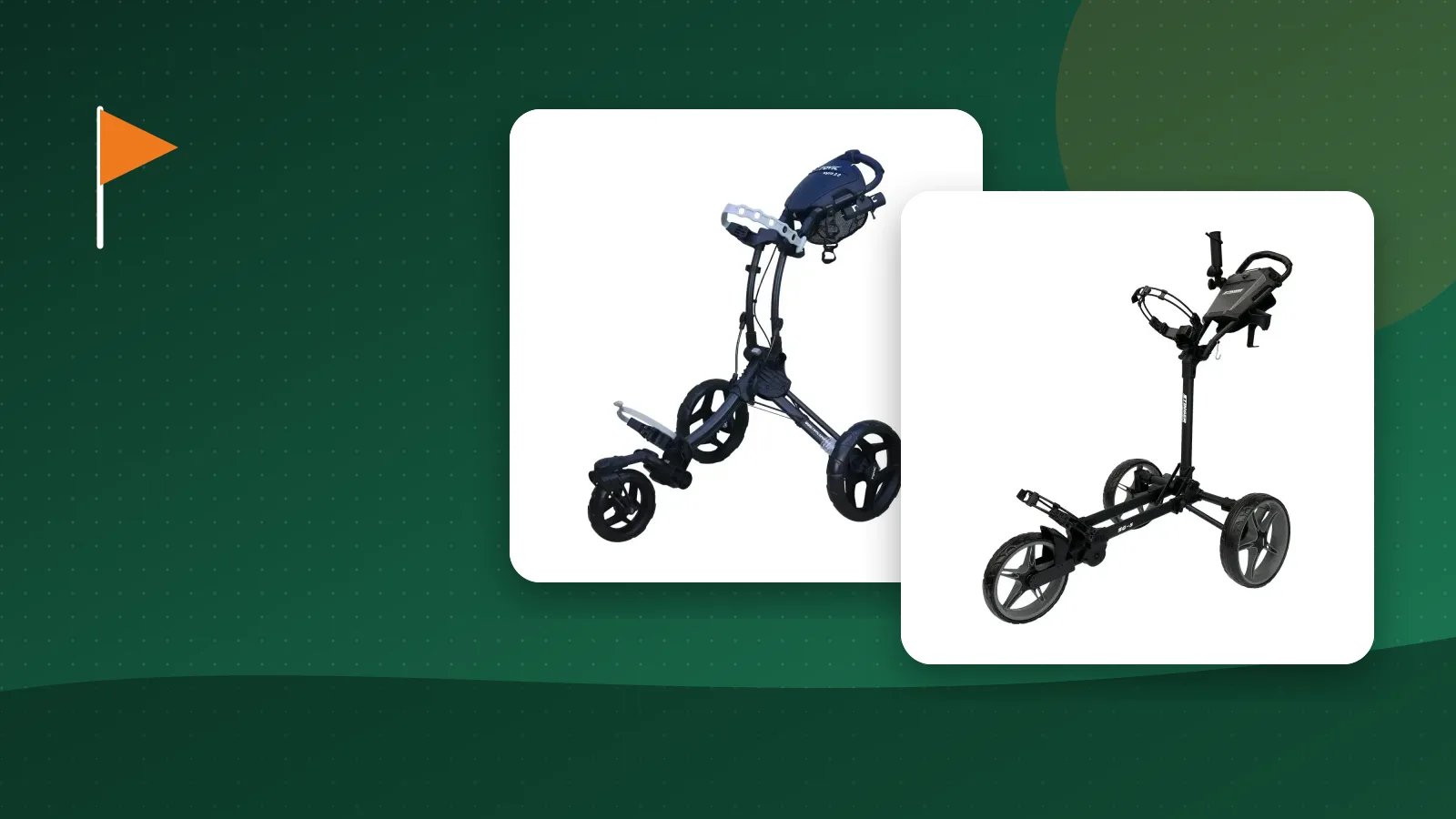
A pull buggy is a golf trolley you walk in front of and tow behind you, while a push buggy is steered from behind. In Australia the two terms are used loosely, and the products on the market today are mostly push-style three-wheelers that can also be pulled, along with a smaller number of traditional two-wheel pull trolleys. If you are searching for a pull buggy, you are really choosing a walking-golf trolley, so this guide explains the differences, what to look for in a frame, wheels and fold, and which models in our range suit different budgets.
Prices are in Australian dollars and include GST. Specifications come from the product pages, and where a page does not state something, we have not stated it either. Ask us if you need more detail.
What is a pull buggy?
A pull buggy carries your bag so you do not have to. Traditional pull trolleys have two large wheels and a handle, and you tow them by the handle while walking. Push buggies have three wheels, which keeps the trolley balanced and allows you to steer with one hand. Both do the same job, which is saving your back and shoulders over eighteen holes. The history and design of golf trolleys is outlined in the golf trolley article on Wikipedia.
You can see the full range in our push and pull trolleys category, and motorised alternatives are under motorised electric golf buggies. For the wider picture, start at the golf buggies hub.
Pull or push: which should you choose?
Pulling is simple and cheap. A two-wheel pull trolley has fewer parts, folds small and costs less. Its drawbacks are stability and strain. The bag swings behind you, it can tip on slopes, and the handle position can drag on your shoulder over a long round. Pushing keeps the weight in front of you where you can see it, and three-wheel designs hold their line on slopes and on fairways with a bit of tilt.
Most modern golfers choose a three-wheel push buggy, and many use it as a pull trolley when a narrow path or a turnstile makes pushing awkward. If you walk a hilly course, a three-wheeler with a good parking brake is usually the more comfortable choice. If you play a flat course and want the lowest price, a lightweight two-wheel pull or a compact three-wheel will do the job.
Models in our range
The lowest-priced option is the Caddytek 11.5 V3 Superlite Deluxe 3 Wheel Golf Push Buggy at $165.60. In the middle, the Rovic RV1S Swivel 2.0 is listed at $347.90 and has a swivel front wheel. The Stinger SG-5 V2 is $391 and lists a weight of 6.9 kg. If you want some help on hills, the MGI E-Boost Golf Pushcart is listed at $881.

More models are on the brand pages for Stinger, Rovic, Caddytek, Clicgear and PowaKaddy.
What to look for in a pull buggy
Start with the fold. A good trolley folds quickly with one or two moves, and the folded size must fit your boot. Check the weight, because a lighter trolley is easier to lift in and out of the car. Next look at the frame material, the wheel diameter and the handle. Larger wheels roll more smoothly on grass and rough paths, and an adjustable handle height prevents a stooped walk. Make sure the trolley has a parking brake or a lock, since parking on a slope without one is how bags end up rolling downhill.
Finally, look at the bag fit. Most modern trolleys fit cart bags and stand bags, but a few have specific straps. If you carry a large tour bag, check that the base support is wide enough.
Wheels, swivels and the way they roll
Three-wheel trolleys come with fixed or swivel front wheels. A fixed wheel tracks straight and is easier on slopes. A swivel wheel turns more easily around tight bends and can be locked straight for fairways. Rear wheels are usually larger. Foam or EVA tyres need no pumping, while pneumatic tyres roll more smoothly but can puncture. Match the wheels to your course. A hard, hilly layout with sandy bunkers suits large, grippy wheels, and a flat course with concrete paths is happy with small ones.
Storage, accessories and extras
Look for a built-in scorecard holder, drink holder, umbrella mount and a place for your phone. Product highlights for our trolleys note storage for tees, phone and scorecard, and some models fit most cart and stand bags. Add-ons such as seat kits, rain covers and umbrellas are available under golf cart accessories. If you want a seat built in, look at the models listed with seat kits. They add weight but let you rest between shots.
Folding, transport and storage
Check the folded dimensions against your boot and the space at home or in the clubhouse locker. A trolley that needs to be dismantled every time will soon stay in the shed. Test the folding action in person if you can, or check the product page for fold notes. When you store it, wipe off grass and mud, dry the wheels and keep it out of the weather. A trolley stored wet will rust at the bolts and axles.
When to move up to a motorised buggy
If hills, age or injury make walking harder, a powered golf buggy can be a better investment than a manual trolley. Electric buggies carry the bag and drive themselves, and remote-control models follow or move on command. Browse the remote control golf buggies and the motorised electric range to compare. For golfers who want to ride, see ride-on seated buggies.
Care and maintenance
A trolley needs very little care. Wipe the frame after wet rounds, spray the folding joints and axles with a light lubricant now and then, and check that the wheel nuts and clips are tight. Inspect tyres for cracks and replace worn parts rather than waiting for a failure on the course. A motorised pushcart also needs battery care, which means charging it after play and storing the battery as the maker recommends. Before you buy, check Product Safety Australia for any recall notices that apply to the model you are considering.
Buying and delivery
Orders over $1,000 ship free to major metro and depot corridors, and a flat $95 charge applies below that. The minimum order is $250, so a single trolley may be combined with accessories to reach it. We accept bank transfer (Osko or EFT), PayID and crypto, and if you choose crypto at checkout a 10% discount is applied automatically. If you want help choosing, call +61420128746 or send an enquiry.
Pulling versus pushing: comfort and technique
How you use the trolley matters as much as which one you buy. When you push, keep your arm relaxed and let the trolley track in front of you rather than gripping the handle hard. Use the parking brake on slopes, tee boxes and greens, and avoid leaving the trolley unattended on a hill. On narrow bridges or steep paths, many golfers pull the trolley behind them, which is easier on tight sections, so a trolley that handles both ways has real value.
Weight distribution makes a difference as well. Place heavier items such as water and balls low in the bag, and avoid hanging loose items from the handle, because that can tip the trolley when you turn. If your bag is heavy, check the trolley's load limit on the product page, and fit the bag so that the base sits firmly on the support.
Rain, mud and winter golf
Wet courses are hard on trolleys. Wheels clog with mud and grass, brakes become less effective and the frame holds water in the joints. After a wet round, hose off the wheels, wipe down the frame and leave the trolley unfolded to dry, then fold it for storage. A rain cover protects the bag and the trolley's accessories, and an umbrella holder is handy if you play in showers. Check the wheel bearings occasionally. If the wheels start to feel gritty, clean and lubricate the axles with a light lubricant as the maker advises.
Trolley seats and rest stops
Some golfers want a seat as part of the trolley, especially older players or those with injuries or fatigue issues. Models listed with seat kits add a fold-down seat so you can rest while others play. A seat adds weight and may change how the trolley folds, so test the combination before you commit. For golfers who need regular rests or find walking difficult, a powered golf buggy or a ride-on seated buggy may be a better answer.
Matching the trolley to your game
Think about how often and where you play. A club golfer who plays weekly on a hilly course will notice the difference between a basic and a well-made trolley within a few rounds, while an occasional player on a flat public course may be happy with a simple model. Think about your bag as well, since a heavy tour bag needs a stable base. Whatever you choose, fold it and unfold it a few times at home so that you are confident using it before your next round.
Bottom line
A pull buggy is the cheapest way to stop carrying your clubs, and a three-wheel push buggy is the most comfortable on hilly courses. Choose by fold size, weight, wheels and bag fit, then match the price to how often you play. Browse the push and pull trolleys or ask us to recommend a model for your course. If you were actually looking for a motorised machine rather than a golf trolley, our off-road buggies range covers go karts, quads and side by sides.


