Buying guides · 7 min read
Electric Golf Buggy vs Push Buggy: Which Should You Buy?
A push buggy costs a few hundred dollars and needs no charging. An electric buggy adds a motor and a bigger price. Here is how to choose.
By the Buggies For Sale team · Updated
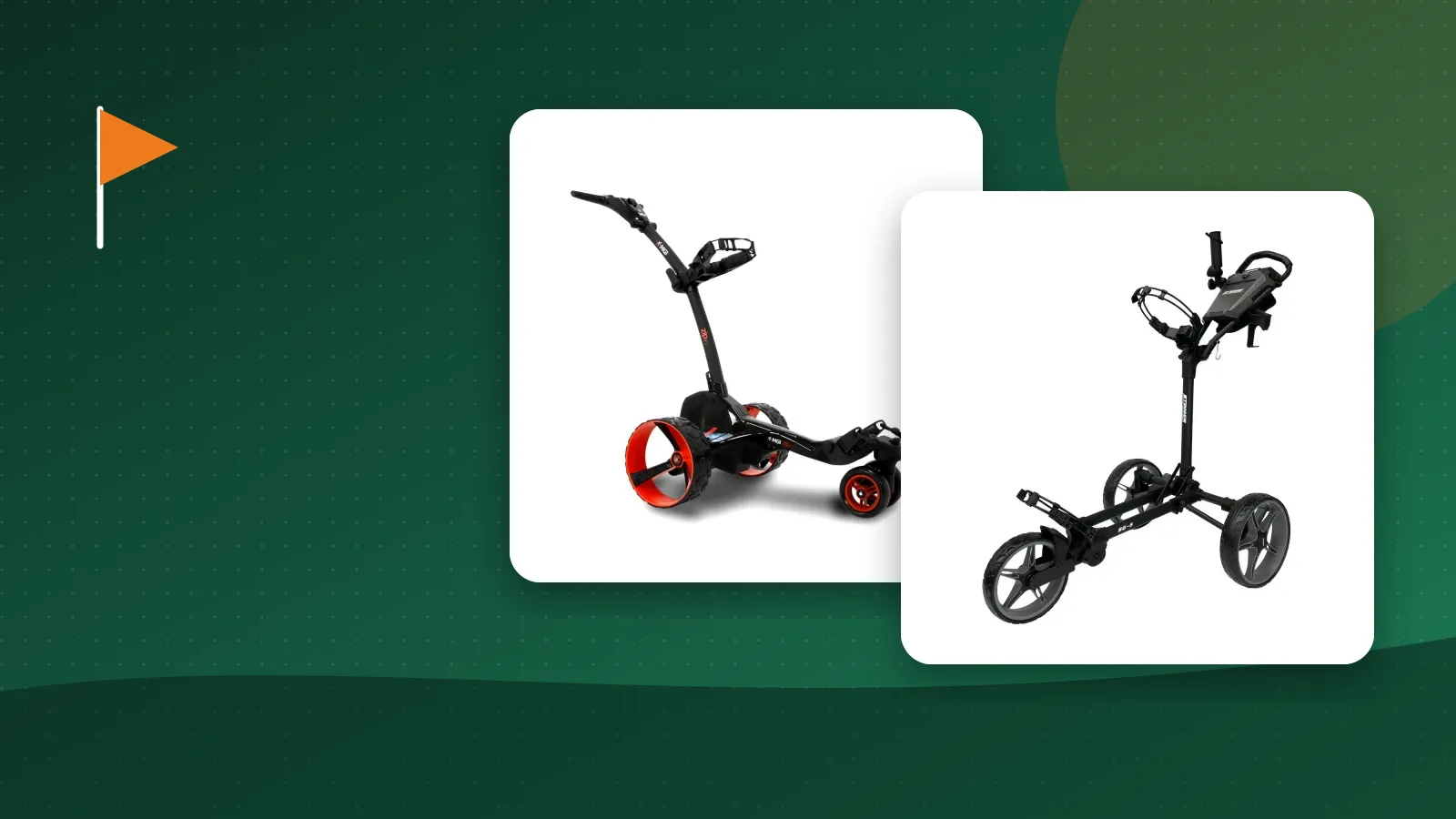
Most golfers who stop carrying their bag end up choosing between a push buggy and an electric buggy. Both save your back, but they suit different golfers and budgets. This guide helps you decide.
Push buggies in a nutshell
A push (or pull) buggy is a light, foldable frame with wheels. You push it, steer it and pull it up slopes. There is no motor and no battery. Models like the Stinger SG-1 and SG-5 fold quickly and include handy storage.
Push buggies are the lowest cost way to stop carrying your clubs, and they never run out of power. Browse our push golf buggies to compare.
Electric buggies in a nutshell
An electric buggy adds a motor and a rechargeable battery. You steer and the buggy does the work, including up hills. Models like the MGI Zip X3, PowerBug NX and QOD Q1 fold compact and use lithium batteries. See our electric golf buggies.
Side-by-side comparison
- Price. Push buggies are the cheapest. Electric buggies cost several times more.
- Effort. Push buggies need effort on hills. Electric buggies take the load.
- Weight. Push buggies are lighter to lift into the car. Electric buggies weigh more because of the motor and battery.
- Maintenance. Push buggies need almost none. Electric buggies need battery care and charging.
- Features. Electric buggies can add GPS, downhill control and parking brakes.
Who should buy a push buggy?
A push buggy suits golfers on flat or gently rolling courses, golfers who want the lowest cost and golfers who like to keep things simple.
Who should buy an electric buggy?
An electric buggy suits golfers on hilly courses, golfers who want to save energy for the round and golfers who play often enough to justify the cost.
What about remote control?
Remote buggies take electric buggies one step further, following your commands so you walk hands-free. They cost more and suit golfers who value speed and convenience. Read our remote control golf buggy guide for more.
Check before you buy
- Will it fold small enough for your boot?
- Does your golf bag suit the bag holder?
- Is the battery lithium and what is the range?
- What accessories do you want? See our accessories for umbrella and phone holders.
Our advice
If you are unsure, start with the course. A flat course suits a push buggy. A hilly course suits an electric buggy. Ask us if you want a hand: 0420 128 746.
Cost of ownership
A push buggy has no battery, charger or motor to replace, so ownership cost is mostly tyres and the odd repair. An electric buggy costs more up front and has a battery that will eventually need replacing, but it saves effort every round. Think about how often you play and how hilly your course is.

Hills, fitness and age
On a flat course a push buggy is easy and keeps the cost low. On a hilly course, or if you want to save energy for your swing, an electric buggy takes the strain. Many golfers move from push to electric as courses or fitness change.

Course rules and etiquette
Most courses allow both push and electric buggies, but some have restrictions on certain models or on wet days. Check with your club, and use Golf Australia as a starting point for the sport and its clubs. Read our guide to golf e-scooters if you are considering a ride-on instead.
Quick decision guide
- Walk flat courses, tight budget: push buggy.
- Hilly course or limited energy: electric buggy.
- Want the least effort: a remote control golf buggy.
Browse electric golf buggies and push and pull buggies to compare models and prices.
How each type works in practice
A push buggy is a lightweight frame with three or four wheels that you push or pull by the handle. It carries your bag, folds for the boot and has no electronics to fail. An electric buggy adds a motor, a battery and a controller. You set a speed, the buggy drives itself, and you walk beside it. Remote control buggies go a step further and move on command, while follow-me systems track you automatically. All three share a wheelbase and frame, so the main decisions are effort, weight and cost.
Weight, storage and transport
Push buggies are the lightest and fold the smallest, which makes them easy to lift into a car or carry up stairs. Electric buggies weigh more because of the battery and motor. Look at the folded dimensions and the weight with the battery installed. If you have a small boot or a bad back, a lithium electric buggy that folds in two steps can be a better fit than a heavier lead-acid model. Check whether the battery comes out for charging and for lifting.
Battery life, range and charging
A battery rated for 18 holes covers most golfers, but real range depends on hills, wind, the weight of your bag and whether you use the buggy in cold weather. Many players choose a battery for 27 or 36 holes so they never think about it. Lithium batteries are lighter, hold their power longer and recharge faster than lead-acid. Charge after every round so the battery is ready, and store it somewhere cool and dry. Our lithium batteries and chargers cover common models.
Bags, accessories and fit
Both buggy types carry cart bags and stand bags, but the way the bag attaches differs. Check that the bag bracket fits your bag and that the straps hold it securely. Useful accessories include umbrella holders, drink holders, scorecard and GPS holders and a seat for rest breaks. Browse our golf cart accessories for add-ons.
Who each buggy suits
- The weekend player on a flat course: a push buggy keeps cost and complexity low.
- The regular player on a hilly course: an electric buggy saves energy and helps you play better late in the round.
- A golfer who struggles with pushing: an electric buggy reduces strain on the hands, back and shoulders.
- A technology fan: a remote control or GPS buggy with distance readouts is a fun upgrade.
- A golfer who travels: a very light folding buggy that fits in a boot or a travel bag.
Common mistakes to avoid
Buying on price alone is the most common mistake. A cheap electric buggy with a weak battery or no spare parts can become an expensive paperweight. Another mistake is ignoring how the buggy folds, so check it in the shop or watch a demonstration video. A third mistake is not checking your club's rules on powered buggies. Finally, many golfers forget to budget for a spare battery or a travel cover.
Maintenance checklist
- Wipe the frame and wheels after wet rounds.
- Check tyre pressure and tread, especially on pneumatic wheels.
- Lubricate moving parts and folding joints occasionally.
- Charge the battery after every round and avoid deep discharge.
- Store the buggy folded and dry, with the battery partly charged.
Which should you buy?
If you are unsure, start with the number of rounds you play and the hills on your course. Fewer rounds and flat terrain favour a push buggy. More rounds, hills or a desire to save effort favour an electric buggy. When you are ready, compare options in our push and pull golf buggies and electric golf buggies. If you want hands-free control, read our remote control golf buggy guide.
Real-world scenarios
Consider three golfers. The first plays nine holes on a flat local course once a week and walks briskly. A push buggy is ideal: light, quiet, and with nothing to charge. The second plays eighteen holes twice a week on a hilly course and has a sore shoulder. An electric buggy with a lithium battery removes the strain and keeps energy for the back nine. The third travels for golf and flies with clubs. A very light folding push buggy or a compact electric buggy with a removable battery avoids airline battery restrictions. Your own situation will be a mix of these, so weigh the factors that matter most to you rather than the price alone.
Whichever you choose, try the fold before you buy. A buggy that is awkward to open and close becomes a daily irritation. If you can, test it with your own bag, since bag shape affects how well the straps hold. Ask about spare wheels, brake parts and handle grips, which wear out over time.
Buying tips that save money
Look for last season's models, which often have the same frame with small cosmetic changes. Ask whether the price includes a travel cover, an umbrella holder and a charger, because these add up. Compare warranty lengths for the frame, the motor and the battery separately, and ask whether the warranty is honoured in Australia. If you already own a good push buggy, ask whether a motor conversion kit exists for it, but check that the frame is rated for the extra weight.
