Buying guides · 10 min read
Best Golf Push Buggy Australia: How to Choose the Right One
Best golf push buggy Australia: compare 2, 3 and 4 wheel push buggies from $234, fold sizes and features, then pick the right one for your game.
By the Buggies For Sale team · Updated
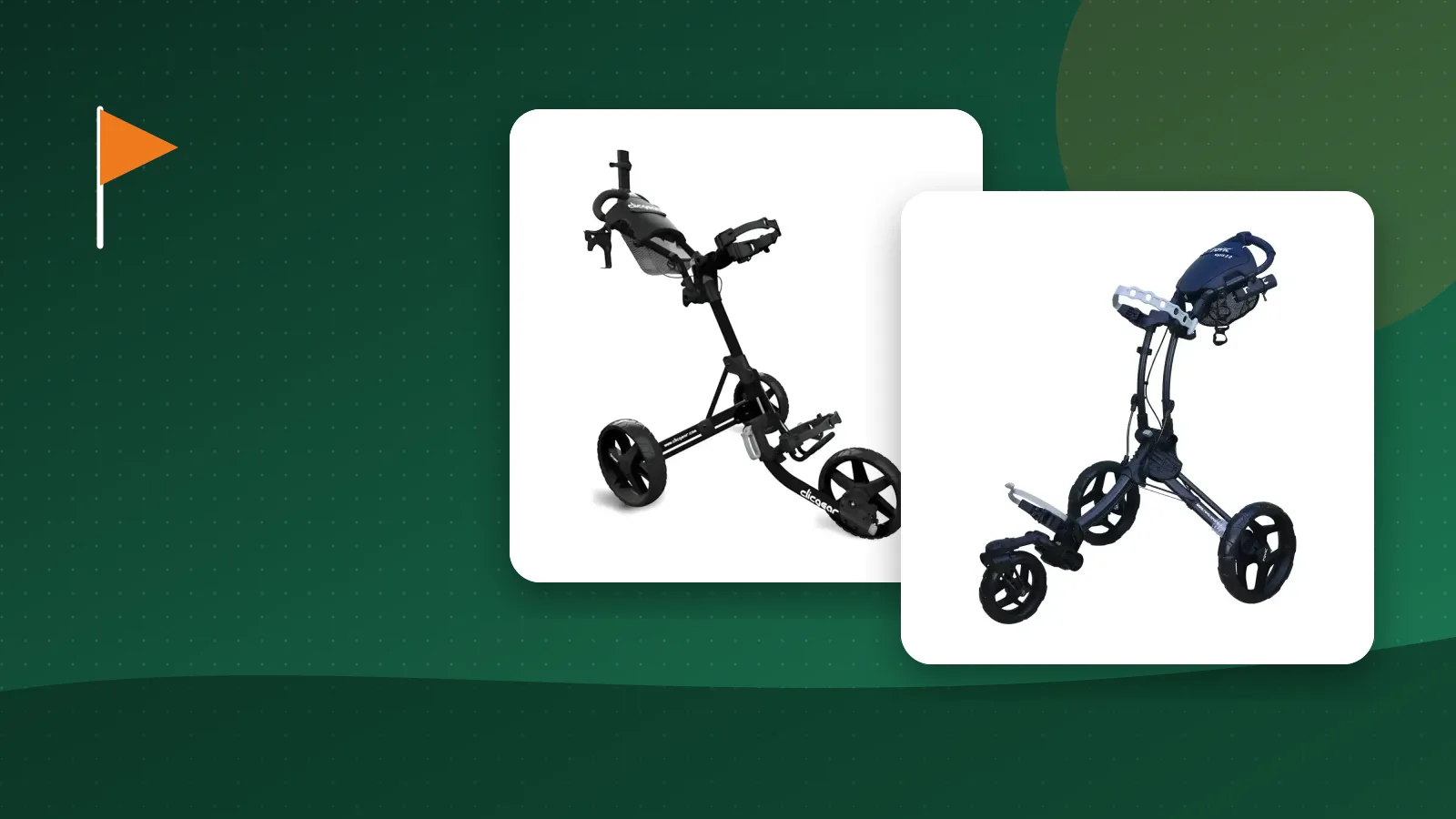
The best golf push buggy in Australia is the one that suits your car boot, your course and your back. There is no single winner, because a golfer who plays a flat course twice a week needs something different from one who walks hilly country with a heavy bag. A push buggy has no motor or battery, so the buying decision is simpler than for an electric model, but the differences between wheel layouts, weights and fold sizes are real. This guide explains how to choose, what the specifications mean and how the push buggies we stock compare, using the prices and specifications as published on our product pages.
What is a golf push buggy?
A golf push buggy, also called a push trolley or push cart, is a wheeled frame that carries your golf bag while you walk and push it. It has no motor. Most fold flat for the boot, and prices are far lower than electric models. In our range push buggies start at $234 and run to $470 for the standard models, with a motorised pushcart higher up. For the wider overview, read our push trolley guide and our category of golf push-pull trolleys.
Many golfers start with a push buggy and upgrade later. If you are deciding between push and electric, our electric versus push golf buggy guide helps you weigh up price against effort.
Wheel layouts: 3-wheel or 4-wheel?
Most push buggies have three wheels: two large rear wheels and a smaller front one. Three-wheel models are light, fold small and are easy to steer in a straight line. Some have a swivelling front wheel for sharper turns, and some let you lock the wheel for hilly or rough ground. Four-wheel designs are more stable and hold the bag steadily but take up more space. Which is best depends on your course and your boot.
The Triumph GTX Plus 3-Wheel Golf Push Buggy is $353 and has 5 inch wheels listed. The Rovic RV1S Swivel 2.0 at $348 has a swivel front wheel, and the Rovic RV1C Compact 2.0 at $332 folds compact for small boots.

Stinger push buggies
Stinger is the biggest push buggy name in our range, with a step-by-step price ladder. The Stinger SG-1 is $234 and weighs 5.9 kg. The SG-3 VIII is $273, the SG-2 V2 is $293, and the SG-4 Compact is $313. The SG-5 V2 is $391 and weighs 6.9 kg, and the SG-6 is $460. The SG-5 V2 with seat kit is $479. See the Stinger brand page for the lot.
Other brands worth a look
The Clicgear Model 4.0 is $381. The PowaKaddy Micra is $391 and the Big Max IQ2 360 is $470. Browse the Clicgear, Rovic, Triumph and Big Max pages for the full lines. For a higher-priced option, the MGI E-Boost Golf Pushcart is $881.
Specifications that matter
- Weight: you lift the buggy in and out of the boot, so a lighter frame is easier. The SG-1 at 5.9 kg is light, the SG-5 V2 at 6.9 kg is a step up.
- Folded size: measure your boot. A buggy that does not fit is of no use.
- Wheel size and type: larger wheels roll more easily over rough ground and wet grass. Smaller wheels fold neater.
- Front wheel: swivel for easy turns, lockable for straight tracking on slopes.
- Bag attachment: straps and a bag base that suit your bag. Check it works with a cart bag or a stand bag.
- Accessories: umbrella holder, drink holder, phone holder, scorecard holder and a seat kit.
- Brake: a parking brake keeps the buggy still on slopes.
Matching a push buggy to your course
Flat, firm courses are kind to most push buggies, so choose on weight and fold size. Hilly courses are harder work, so favour a stable frame with a good brake and consider an electric model. Wet courses and soft ground favour larger wheels, since small wheels can sink. If you play many courses, a compact fold that fits any boot saves hassle.
Accessories that make a difference
Over four hours, small items matter. A phone holder at $19, an umbrella holder and a drink holder are inexpensive. A rain cover at $185 protects the bag. Browse our phone, umbrella and drink holders category, and check any accessory fits your model before you order. The background to golf equipment is explained in the golf article on Wikipedia.
Push buggy care
A push buggy needs very little. Wipe it down after wet rounds, dry the wheels, keep axles and folding joints clean and a drop of oil on moving parts now and then. Check tyres for wear and the frame for damage, particularly if you store it in a boot with loose gear. A buggy stored dry lasts for years.
When to move up to electric
If pushing is wearing you out, an electric buggy is the next step. Entry models start at $636 for the Thomson E5000 Pro and $862 for the PowerBug NX. See our electric golf buggies and our guide to the best electric golf buggy in Australia.
How to test a push buggy before you buy
If you can, handle a push buggy in person, or at least study the specifications carefully. Check the folding action: does it fold with one hand and lock securely? Check how the handle feels at your height, because a poorly positioned handle strains the back. Imagine pushing it uphill with a full bag and think about the brake. Compare the folded dimensions with your boot, including the space the bag will need alongside it. These small checks help you avoid regret. If you order from us, read the product page carefully and ask questions before you buy.
Bag fit and balance
A push buggy only works well with the right bag. Cart bags with a flat base and handles on the sides sit steadily on most frames. Stand bags can be awkward on some trolleys, because the legs catch on the frame. Check how the bag attaches, whether there is a strap or a bungee, and whether the bag base fits the cradle. Balance matters on slopes: a heavy bag sitting too high or too far back makes the buggy tip. Put heavier items at the bottom of the bag and keep the weight centred.
Budget guide
It helps to think of push buggies in three price bands. The first band, up to about $300, covers simple, light models like the Stinger SG-1, SG-3 and SG-2. The second, from about $300 to $400, adds more features and sturdier builds, such as the Stinger SG-4 and SG-5, Rovic, Triumph and Clicgear models. The third, above $400, includes the Stinger SG-6 and Big Max IQ2 360. Go for the band that suits how often you play. A golfer who plays once a fortnight rarely needs the top band, while someone who plays four times a week will notice the difference in build and features.
Mistakes to avoid
Do not buy on price alone: a buggy that is too heavy or does not fit your boot is no bargain. Do not ignore the wheel layout, because it affects how the buggy steers and folds. Do not forget the bag: check it works with the frame. And do not skip the care routine; a quick wipe after a wet round keeps the frame and wheels in good condition for years.
Storing and transporting your push buggy
Fold the buggy before it goes in the boot, and lay it so the wheels do not press on the bag or other gear. Keep it away from heavy items that could bend the frame. At home, store it dry, ideally hung or stood upright, so the wheels and joints stay clean. A buggy that is stored properly folds smoothly, and that makes the pre-round routine quicker.
Warranty and support
Check what warranty the manufacturer lists for the frame and wheels, and keep your receipt. If a wheel or a fitting wears out, a replacement is usually cheap, so ask the seller whether spare parts are available before you buy. A push buggy that can be repaired is better value than one that has to be replaced.
Buying a golf push buggy from us
All prices are in Australian dollars and include GST. We confirm stock and freight to your postcode before you pay. The minimum order is $250, so pair a buggy with accessories or a second item if you need to reach it. You can pay by bank transfer (Osko or EFT), PayID or crypto, with a 10% discount applied automatically when you choose crypto at checkout. Orders over $1,000 ship free to major metro and depot corridors, and a flat $95 freight charge applies below that. Call +61420128746 if you want help choosing.
Bottom line
The best golf push buggy in Australia is the one that is light enough to lift, folds to fit your boot and rolls well on your course. Start with weight and fold size, choose a wheel layout, then add the accessories you will use. With prices from $234, a push buggy is the lowest-cost way to take the weight off your shoulders.


