Buying guides · 10 min read
Dirt Buggy Guide: How to Choose the Right One in Australia
Choosing a dirt buggy in Australia? Compare side-by-side and dune styles, learn what to check on tyres and engines, and see models from $3,429.
By the Buggies For Sale team · Updated
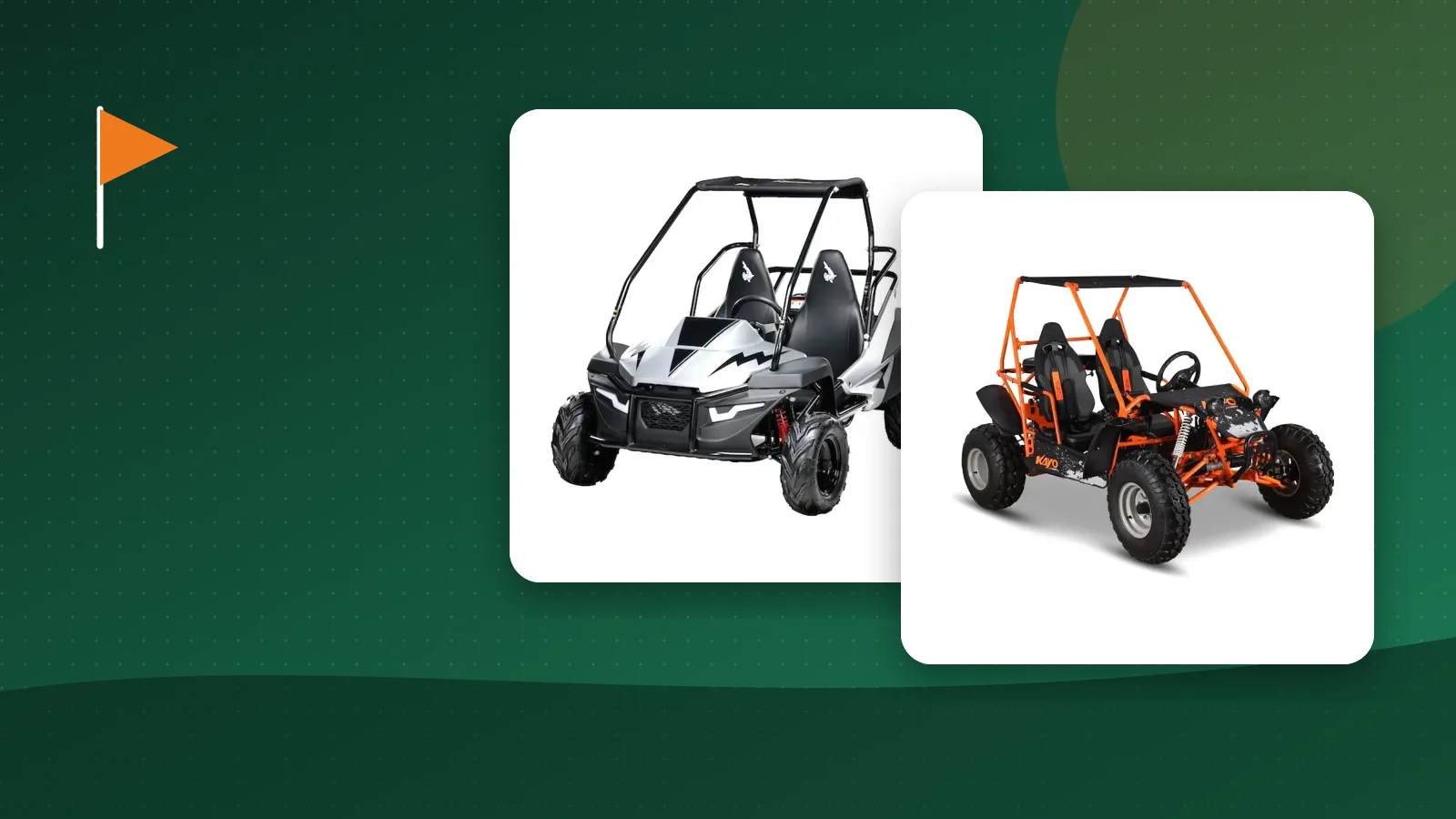
A dirt buggy is a small off-road vehicle built for loose ground: paddocks, fire trails, bush tracks, sand and mud. For some owners it is a weekend toy, for others it is a useful farm runabout, and for many it is a bit of both. The word "dirt buggy" covers several different machines, and choosing the wrong one is the most common mistake. This guide explains the main types, what to check before you buy and which dirt buggies we stock, with the specifications and prices exactly as we publish them.
What is a dirt buggy?
There is no formal definition, so shoppers use the term for any compact off-road buggy that is happiest on dirt. In practice it usually means one of three things: a side-by-side style buggy where two people sit next to each other, a dune buggy with an open frame and a rear engine, or a small youth buggy. Each behaves differently, so the first decision is the type, not the brand. For a plain-English comparison of the wider family, read our guide to UTVs, side-by-sides, ATVs and dune buggies.
Side-by-side dirt buggies
A side-by-side style buggy has two seats beside each other, a steering wheel, roll protection and usually a small cargo area. It is the most practical type because it carries a passenger and gear, and it handles farm and property work as well as fun. The Hammerhead Mudhead SE Off-Road Buggy is the lowest-priced model in this group at $3,429. The Kayo S150 Side by Side Buggy is $4,213, and the larger Kayo S350 Side by Side is $8,819. Our side-by-sides and UTVs category lists the bigger, heavier machines from brands such as Polaris, Kubota and Honda.

Our product pages describe these as work and recreation machines with an off-road side-by-side layout. We recommend you check the assembly and delivery notes on each page, because buggies in this class can arrive partly assembled and need final fitting.
Dune-style dirt buggies
A dune buggy is lighter and more open. The driver sits in a tubular frame with big rear tyres, and the engine sits behind. It is happiest on sand and open dirt, and many people choose one for the fun of it rather than for work. We stock the Trailmaster Cheetah 175cc Dune Buggy at $4,557, the Cheetah 300cc at $5,879 and the Trailmaster Challenger 200 at $6,223. See the full dune buggies range and our Trailmaster brand page for details.
Youth dirt buggies
Smaller riders need smaller machines. A youth buggy has a limited engine or motor size, a reduced top speed and usually a safety feature such as a tether. We list models such as the Kayo S70 Kids Buggy with a 79cc engine, listed at $1,469, and the Hammerhead Torpedo Kids Buggy at $2,253. Always supervise children, require a helmet and match the machine to the child's age and size. Our kids buggies category lists them all.
How to choose between them
Start with three questions. First, who will ride? If you need a passenger or you want to carry tools, a side-by-side is the natural choice. If it is just you chasing a good time on sand, a dune buggy fits. If it is for a child, look at youth models. Second, where will you drive? Hard-packed dirt tolerates almost anything, but deep sand, mud, rocks and steep climbs all demand more from the suspension, tyres and drivetrain. Third, how will you move it? A buggy that does not fit your trailer or ute is a poor buy.
What to check on the spec sheet
- Engine size: quoted in cc. Larger engines give more pulling power, but they also use more fuel and cost more to service.
- Drive: two-wheel drive is lighter and cheaper, while four-wheel drive copes better with mud and steep ground. Confirm the drivetrain on the product page.
- Tyres: knobby tyres bite into dirt, paddle tyres float on sand. Tyres are the cheapest upgrade with the biggest effect.
- Suspension travel: more travel makes rough tracks more comfortable and keeps the wheels on the ground.
- Safety structure: look for a roll cage, seat belts and a clear note on required safety gear.
- Weight and size: check this against your trailer, your gate widths and the tracks you plan to drive.
Safety and where you can drive
A dirt buggy is generally intended for private land or approved off-road areas rather than public roads. Rules vary between states and local councils, and public land such as national parks has its own access rules, so check before you load up. Safe Work NSW publishes guidance for workplaces that use off-road vehicles on farms and properties, and it is a good starting point if you plan to use a buggy for work. Wear a helmet, closed shoes and eye protection every time, wear seat belts where fitted and never carry more passengers than there are seats.
Accessories that help on the dirt
Dirt means dust, bumps and wear. Common accessories include brush guards, windscreens, bumpers and winches. We list Polaris items such as a front brushguard for the RZR 170, and our off-road parts category covers wheels, tyres, winches and tow bars. For moving your buggy, look at trailers and tie-downs and a proper folding ATV ramp, which is listed at $805 and rated for 680 kg. Our guide to UTV accessories goes through what is worth buying first.
Maintenance after a dirty ride
Dirt is hard on moving parts. After a ride, wash off caked mud, check the air filter, look at the tyres and suspension for damage and make sure nothing has loosened. Clean the air filter more often in dusty conditions. Check fluids, brake pads and chain or driveshaft condition at regular intervals, following the manufacturer's schedule. Store the buggy under cover where possible. A short check after each ride is cheaper than a repair after a breakdown.
Choosing tyres for your dirt
Tyres matter more than most buyers expect. On hard-packed dirt, a mild all-terrain tread gives a smooth ride and long life. On wet clay or mud, a deeper tread clears the surface and keeps traction. On sand, a paddle or wide, low-pressure tyre keeps the buggy on top. Many owners keep a second set of tyres for the second type of ground they drive on most. Tyre pressure matters too: a lower pressure spreads the contact patch and improves grip on soft ground, but it increases the risk of the tyre rolling off the rim, so follow the manufacturer's guidance. Our off-road wheels and tyres category lists the options.
Reading the ground before you drive
A good dirt driver reads the surface before the buggy reaches it. Look for ruts, rocks, washouts and soft patches, and slow down before you hit them, not after. Wet dirt behaves very differently from dry. A track that is easy on Tuesday can be slippery on Wednesday after rain. Avoid crossing water of unknown depth and avoid steep descents where you cannot see the bottom. If you are unsure, get out and walk the section first. A few minutes on foot is cheaper than a recovery.
Ride with a plan
Tell someone where you are going and when you expect to return, especially on large properties or bush tracks where phone coverage may be poor. Carry water, a basic first aid kit, a tyre repair kit and a tow strap. Ride with a friend if you can. These steps cost little and make an enormous difference if something goes wrong.
New or used?
Used dirt buggies can look like bargains, but wear on dirt machines is hard to see. Check for bent suspension arms, cracked welds, worn bushes, leaking seals and a tired clutch or drive belt. Ask for service records and take the buggy for a proper test drive on uneven ground. A new buggy costs more up front but comes with a defined specification and a seller you can ask questions of, which counts for a lot if it is your first.
Buying a dirt buggy from us
All of our prices are in Australian dollars and include GST. We confirm stock and freight to your postcode before you pay. You can pay by bank transfer (Osko or EFT), PayID or crypto, with a 10% discount applied automatically when you choose crypto at checkout. Orders over $1,000 ship free to major metro and depot corridors, a flat $95 freight charge applies below that, and the minimum order is $250. If you are unsure whether a side-by-side or a dune buggy suits your property, call +61420128746 and tell us about your terrain. Start with our off-road buggies range to see everything we stock.
Bottom line
The best dirt buggy depends on who rides, where you drive and how you will transport it. A side-by-side such as the Hammerhead Mudhead SE or Kayo S150 handles work and play, a dune buggy such as the Trailmaster Cheetah suits sand and open ground, and a youth buggy keeps younger riders in a size that fits. Check the spec sheet, plan your safety gear and choose the simplest machine that does your job.


