Buying guides · 10 min read
Electric Buggy for Adults: Types, Prices and How to Choose
Wondering which electric buggy for adults fits you? Compare electric go karts, golf buggies and electric UTVs with real prices. See the options today.
By the Buggies For Sale team · Updated
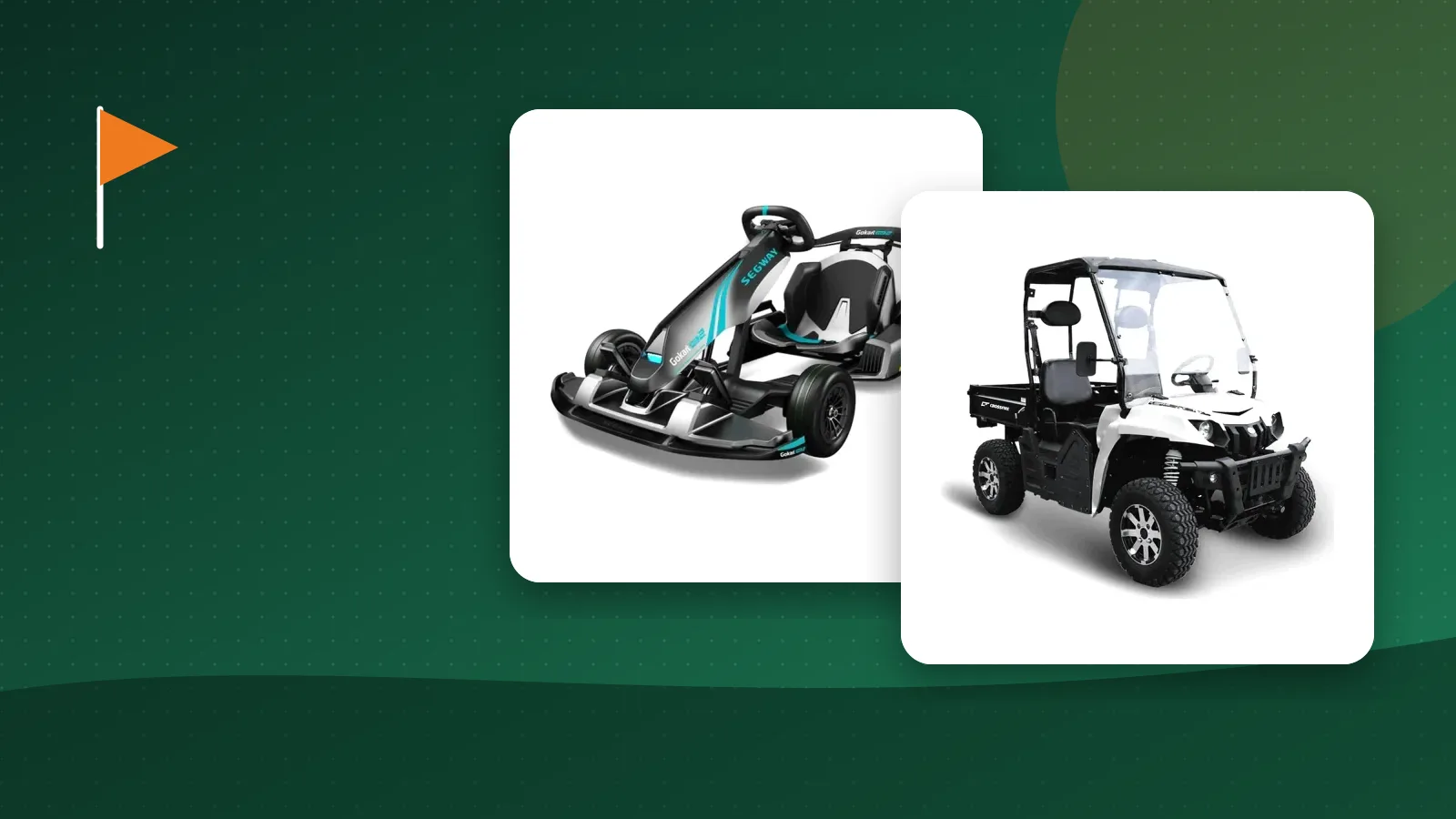
An electric buggy for adults can mean three quite different things. It might be an electric go kart that you drive for fun, an electric utility vehicle that works on a farm or large property, or a battery-powered golf buggy that carries you and your clubs around the course. The common thread is the electric drive: quiet, easy to start, low on maintenance and free of fuel. This guide explains the types, what to compare, what each costs in our range and what to think about before you buy, using only the specifications and prices we publish.
Why choose an electric buggy?
Electric buggies have a few clear strengths. They start instantly, with no pull cord and no choke. They are much quieter than petrol machines, which is useful on a small property or near neighbours. They have fewer moving parts to service, with no engine oil, spark plugs or carburettor to deal with. And running costs are low, because charging is cheap compared with fuel. The trade-offs are range and recharge time: a battery only holds so much energy, and once it is empty you wait for it to charge. The science behind these packs is summarised in the electric vehicle battery article on Wikipedia.
Type one: electric go karts
An electric go kart is the sporty end of the market. It seats one adult at low height and is designed for fun on private tracks, farms or large yards. The Segway Ninebot GoKart Pro 2 is listed at $2,842 with a 450W motor, a 432Wh battery, a top speed of 43 km/h, a range of up to 25 km and a weight of 48 kg. The Crazy Kart Electric Drift Kart Drifta is $1,861 and is built for sliding rather than speed. Our electric go karts for adults guide covers this type in detail, and our go karts category lists the whole range.

Type two: electric UTVs and side-by-sides
If you want an electric buggy that does real work, look at an electric UTV. These are larger, seat two people side by side and have cargo space. The Crossfire E5 Electric UTV 2 Seater is listed at $11,759 and has two seats. It suits farms, large properties, resorts and caravan parks where quiet running matters. Check the product page for assembly and delivery notes, and ask us about battery details and charging before you order. Our electric off-road UTVs and side-by-sides categories show the range, and our UTV guide explains the terms.
Type three: electric golf buggies and golf carts
For golfers, an electric buggy is a golf trolley or a seated golf buggy. Walk-behind trolleys such as the PowerBug NX at $862 and the PowaKaddy CT6 at $1,469 carry your bag. Remote models such as the QOD Q2 at $2,254 follow commands. For adults who want to ride, the i-MotionCaddys IM4 Ride-On Electric Golf Buggy is $6,355, with a listed weight of 178 kg, a top speed of 19 km/h, a range of up to 50 km, a 1200W motor and a 36V, 50Ah battery. Full-size electric carts such as the ECAR range carry two to eight people. Our electric buggy guide compares the types, and the golf cart article on Wikipedia gives general background.
How to choose: five questions
1. What will you do with it? Fun, work or golf. This one decision rules out two of the three types.
2. Who rides? One adult, two adults or a group. Seating decides the category.
3. How far do you need to go? Check the listed range and remember that real range depends on load, terrain and temperature.
4. Where will you charge? You need a power point near where you store it, and time to charge between uses.
5. How will you move it? A 48 kg kart fits a ute with a ramp. A 178 kg ride-on or a larger UTV needs a trailer.
Specifications to compare
- Motor power (W): more watts means stronger acceleration and better hill climbing.
- Battery size (Wh or Ah): a larger battery means longer range per charge. Watt-hours is the clearest number for comparing different models.
- Top speed: higher is not always better. A lower, controlled speed suits many adult uses.
- Weight: affects transport, handling and the surface it can cross without damage.
- Battery chemistry: lithium packs are lighter and charge faster. Our lithium versus lead-acid article explains the trade-offs.
- Charger and charge time: check that a charger is included and how long a full charge takes.
Running costs and maintenance
Electricity is far cheaper than fuel, so day-to-day running costs are low. Your main future cost is the battery, which wears with age and use. Charge it after each ride, avoid leaving it flat for long periods, keep it away from extreme heat and store the buggy dry. Tyres, brakes and bolts still need checking, just as they do on any vehicle. If your buggy uses a lithium battery that needs replacing, our lithium batteries category lists packs for golf buggies and carts.
Rules and safety
Electric buggies are quiet, which makes it easy to forget how fast they are moving. Wear a helmet on go karts and off-road buggies, wear seat belts where fitted and keep to private land or approved areas. Public road rules vary by state and treat many of these vehicles as off-road machines, so check with your state transport authority before you plan any road use. On farms, follow work-safety guidance for your state.
Planning your charging setup
Charging is where electric buggy ownership differs most from petrol. Plan it before you buy. You need a power point close to where the buggy is stored, ideally under cover and out of the weather. Check how long a full charge takes and whether you can charge overnight. If your buggy works on a property with no power near the shed, you may need an extension lead rated for the load or a different storage spot. Never charge a battery near fuel, solvents or flammable material, and never cover a charging battery with a blanket or a tarp.
For larger machines such as an electric UTV, work out how many hours of use you need each day. If the battery will not last a full working day, charging at lunch or having a second battery changes the equation. Ask us about charging time and capacity for the model you are considering before you order, and we will pass on the details from the product listing.
Weight, ground and handling
Electric buggies tend to be heavier than petrol equivalents because of the battery. That weight sits low, which helps stability, but it also loads the tyres and can sink into soft ground. On a lawn or golf course, heavy buggies can leave marks, so choose wider tyres and keep to paths when conditions are wet. On rough ground, extra weight helps traction but makes recovery harder. Match the machine to the surface you drive on most.
Resale and long-term value
A well-kept electric buggy holds its value better than a neglected one, but the battery is the main factor. A buggy with a healthy battery and a record of regular charging is far more attractive to the next buyer than one with a tired pack. Keep your receipts, service notes and manuals. If you plan to sell in a few years, take good photos and keep the original packaging if you can.
A short buying checklist
Write down the job, the number of riders, the distance you need, the charging location and the transport plan. Then check the motor, battery, weight and top speed of the shortlisted models, plus whether a charger is included. Finally, call or message the seller with any question that the product page leaves open. Good sellers answer plainly, and the answers help you buy once rather than twice.
Seasonal and weather considerations
Heat and cold both affect electric buggies. Batteries lose some range in cold weather and can be stressed by prolonged heat, so store the buggy in a shaded, ventilated spot and avoid charging straight after a hard ride on a hot day. Wet conditions call for care around electrical components, so follow the manufacturer's guidance on water exposure and never pressure-wash the motor or battery area.
Buying an electric buggy for adults from us
All prices are in Australian dollars and include GST. We confirm stock and freight to your postcode before you pay. You can pay by bank transfer (Osko or EFT), PayID or crypto, with a 10% discount applied automatically when you choose crypto at checkout. Orders over $1,000 ship free to major metro and depot corridors, a flat $95 freight charge applies below that, and the minimum order is $250. If you cannot decide between a kart, a UTV and a golf buggy, call +61420128746 and describe how you plan to use it. Start with our off-road buggies and golf buggies ranges.
Bottom line
The right electric buggy for adults depends on the job. A go kart suits fun, an electric UTV suits work and a golf buggy suits the course. Compare motor power, battery size and weight, think about how you will charge and move it, and buy for the use you have rather than the use you imagine. From $1,861 for the Drifta to $11,759 for the Crossfire E5, there is a fit for most budgets.


