Buying guides · 10 min read
Push Buggy Guide: Golf Push Buggies, Prices and What to Check
Shopping for a push buggy? Our golf push buggy range runs from $165.60 with weights, folds and seat options explained. Compare models and enquire today.
By the Buggies For Sale team · Updated
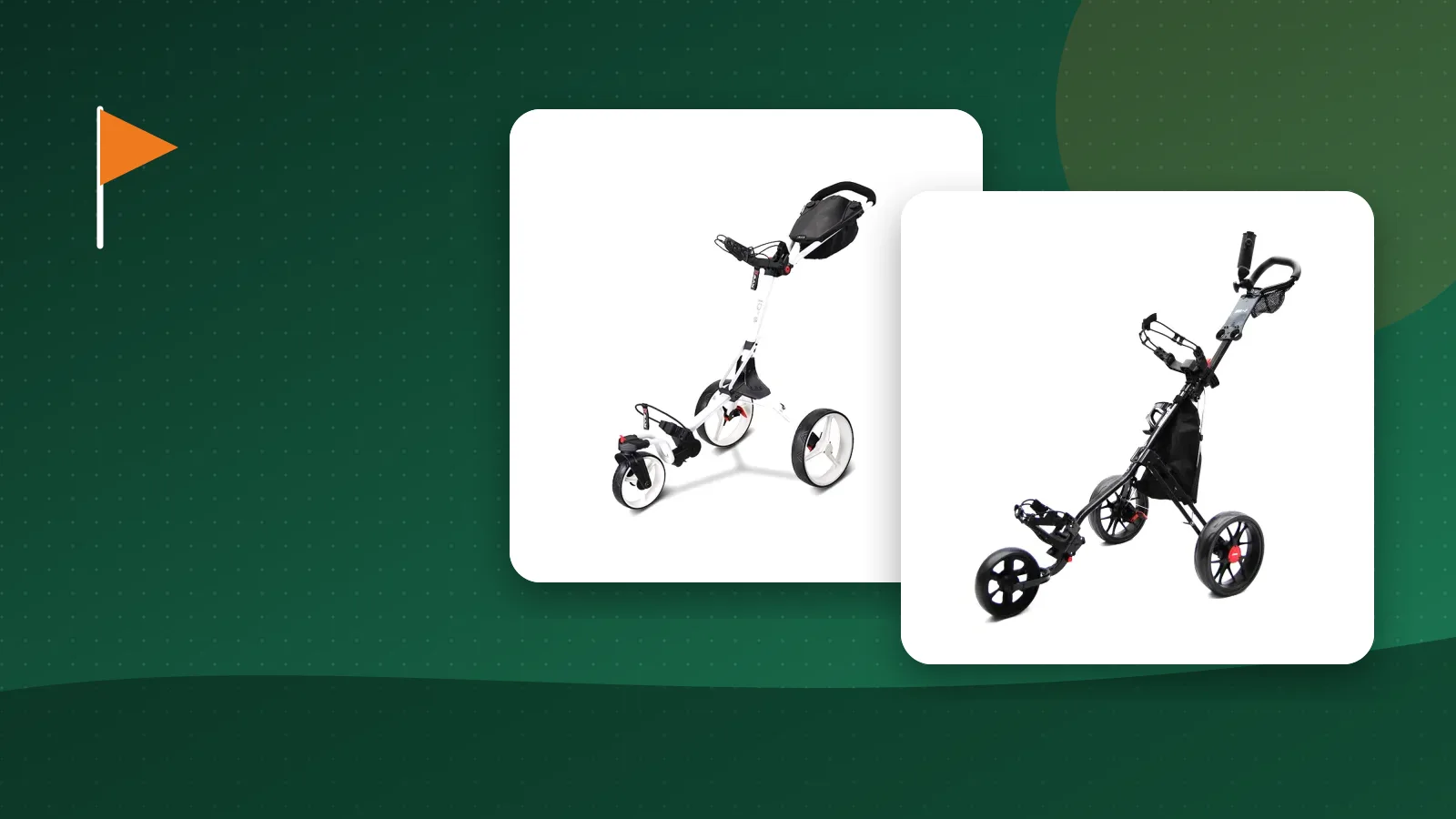
Push buggy is a search term with more than one meaning, and on this site it means a golf push buggy: a manual, wheeled carrier you push down the fairway with your clubs on it. If you came looking for a baby stroller, this is not the right page. If you want to stop carrying a golf bag, read on. This guide explains how golf push buggies work, what separates a $165 model from a $470 one, how to pick between folding styles and what to check before you buy.
All prices are in Australian dollars including GST and come from the product pages. For the full range see our push and pull trolleys category.
What a golf push buggy does
A golf push buggy holds your bag on a lightweight frame with wheels, so you push it instead of carrying it. There is no motor and no battery, so the weight and the cost are low, and you keep the exercise of walking the course. Compared with an electric buggy, it is lighter, simpler and cheaper to run, and compared with carrying a bag it saves your shoulders and back. If you want a motor, our electric golf buggies are the next step. For background on the sport and its gear, see the golf equipment article on Wikipedia.
Price tiers in our range
Push buggies fall into three rough tiers. At the entry level, from $165.60 to about $270, you find simple frames such as the CaddyTek 11.5 V3 SuperLite Deluxe at $165.60, the Stinger SG-1 and the Tri-Lite Deluxe at $234.20 and the Smoothy Micro at $244. In the middle, from about $290 to $390, you find models such as the Stinger SG-2 V2 at $293, the Rovic RV1C at $332.20 and the Clicgear Model 4.0 at $381.20. At the top, around $450 to $480, you find the Stinger SG-6 at $459.60, the Big Max IQ2 360 at $470.35 and seat-equipped models such as the Stinger SG-5 V2 with Seat Kit at $479.20.

The extra money buys a compact fold, better wheels, extra storage or a seat, not a better round of golf. Decide which of those matter to you before you pay more.
Weight and lifting
You lift your push buggy in and out of the car every time you play, so weight counts. The Stinger SG-1 Golf Push Buggy is listed at 5.9 kg, which is light and easy to handle. If the specification is not on a product page, ask us. A light frame is not a weakness, since a good design is sturdy and light, but very cheap frames can flex and wobble when you load a heavy bag.
How the fold works
Folding is the feature that decides whether you use the buggy. Quick-fold designs collapse in one or two moves, which is helpful when you are standing in a car park with your hands full. Compact folds shrink the buggy to a small package that fits a hatchback boot. Check the folded size on the product page, then measure your boot. Some buggies fold flat with wheels off, and others fold with wheels on, and the second type is faster but bulkier. Whatever the model, check the folded dimensions against your own car before you order, and ask us if a figure is not on the page.
Three wheels and two wheels
Most push buggies have three wheels, and a three-wheel layout is stable and easy to steer. Two-wheel designs exist too, and they can be very compact but need the user to balance the bag. See our 3-wheel golf buggies page for the models with a front wheel. If your course has narrow paths or soft ground, a swivel or lockable front wheel helps you steer and track straight.
Bag fit and storage
Check that the bag strap suits your bag, particularly if you use a large cart bag or a narrow stand bag. Most of our push buggies list a fit for most cart and stand bags, but a very big or oddly shaped bag may need extra straps. Look at built-in storage too: a console for tees, a phone, a scorecard and a drink holder make the round easier. Our golf cart accessories page lists extras that suit buggies, including phone and umbrella holders.
Push buggies with seats
A seat is a useful feature for older golfers, for anyone with tired legs and for waiting on the tee. The Stinger range offers seat kits, such as the SG-5 V2 with Seat Kit at $479.20 and the SG-3 VIII with Seat Kit at $361.60. A seat adds weight and cost, and you should check the weight limit before you sit. We do not recommend sitting on any buggy that is not designed for it.
What to check before you buy
Weigh up five things. First, the weight, which affects lifting. Second, the folded size, which affects the boot. Third, the bag fit and strap. Fourth, the wheel quality and the way it rolls on your course. Fifth, the support: ask whether spare parts such as wheels and straps are available. We also recommend reading the descriptions for any care or assembly notes, since some buggies arrive partly folded and need simple set-up.
Push buggy or electric buggy?
If you walk hilly courses or find pushing tiring, an electric buggy takes the effort out of it. Our electric options start at $636 for the Thomson E5000 Pro and rise from there. If you mostly play flat courses and want the lowest cost and the lightest kit, a push buggy is hard to beat. Our guide to electric versus push golf buggies compares the two in detail. Some golfers own both and use the push buggy for quick nine-hole rounds.
Care and storage
A push buggy needs little care. After a wet round, wipe the frame and wheels and let them dry before folding, because trapped moisture can lead to rust and squeaks. Check the wheel fixings and the axle from time to time, and tighten anything loose. Keep the buggy in a dry place, ideally standing upright, so the joints and wheels stay clean. A buggy stored this way folds smoothly for years.
Brands you will see
Our push buggies come from several makers. Stinger covers most of the price range, from the SG-1 to the SG-6, and has seat-kit versions. Clicgear, Big Max, Rovic, Triumph, Bag Boy, Smoothy, Tri-Lite and CaddyTek each offer their own take on the fold and the frame. You can browse them on the Stinger, Clicgear and Rovic brand pages. A well-known brand does not guarantee the best buggy for you, but it tends to mean easier access to parts and clearer information.
Using a push buggy on the course
Push buggies roll well on firm fairways and paths. On soft or wet ground the wheels can sink, and on steep slopes you will need to control the buggy with both hands and keep it from running away. Always check the course rules, since some clubs restrict trolleys on wet days or in certain areas. Keep the bag balanced and strapped, because a top-heavy bag can tip the buggy on a side slope. A bag with the heaviest clubs low and the umbrella clipped to the frame handles better than a loose one.
Take care with the handbrake or parking brake if your model has one. Apply it when you stop on a slope and release it before you move off. If the buggy does not have a brake, turn the wheels across the slope or hold the handle whenever you pause.
Gifts and first-time buyers
A push buggy is a popular gift for golfers because it is useful and easy to size. If you are buying for someone else, check the bag type they use, their car boot and whether they play hilly or flat courses. If you are unsure, a mid-priced model from a well-known brand is a safe choice. Remember that the minimum order is $250, so a gift buggy can be paired with an accessory such as a phone holder or a cooler bag from our golf buggy accessories to reach it.
Before you gift or buy, it is worth asking whether the golfer already owns a cover, a seat or an umbrella holder, since accessories that duplicate what they have are wasted money. A quick message to a family member or golf partner is often enough to find out. If the buyer is not sure which model to choose, tell us the budget and the car and we will suggest two or three options to consider, rather than a long list that makes the decision harder.
Delivery and payment
We confirm stock and freight to your postcode before you pay. Orders over $1,000 ship free to major metro and depot corridors, and a flat $95 freight charge applies below that. The minimum order is $250, so a push buggy at the low end may need an accessory or a second item to reach it. You can pay by bank transfer (Osko or EFT), PayID or crypto, and choosing crypto at checkout gives a 10% discount automatically. Call +61420128746 if you want help choosing.
Bottom line
A push buggy is the simplest, lightest and cheapest way to stop carrying a golf bag. Choose on weight, folded size and bag fit, add a seat only if you will use it and match the price tier to how often you play. When you are ready, browse the full push and pull trolleys range or the wider golf buggies range.


