How-to · 9 min read
12V Golf Buggy Battery: How to Choose, Charge and Replace One
Need a 12V golf buggy battery? Learn how to check voltage, capacity and fit, charge safely and spot a failing battery, then shop 12V lithium options.
By the Buggies For Sale team · Updated
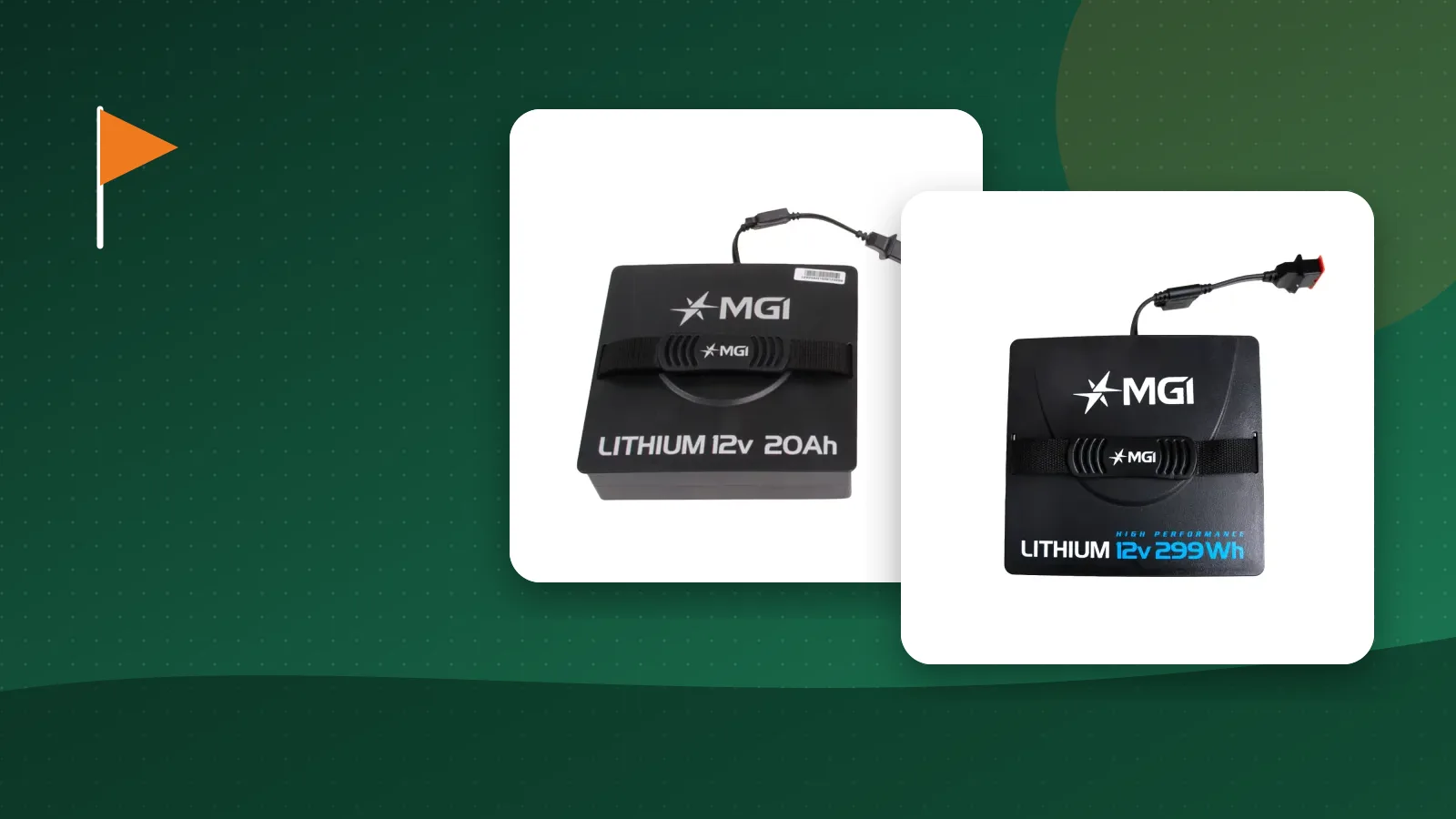
When an electric golf buggy starts to run out of puff halfway round the course, the battery is almost always the first suspect. Many golf buggies and trolleys are powered by a 12V battery, and a worn one is cheap to replace compared with the buggy itself. The trick is buying the right one. A 12V golf buggy battery has to match the voltage, capacity, size and connector of the original, and it has to be charged the right way. This guide explains what the numbers on a 12V battery mean, how to choose a replacement, how to charge and store it and how to tell when it is time to retire it.
What does 12V mean on a golf buggy battery?
Voltage describes the electrical pressure the battery supplies. Twelve volts is a common choice for golf buggies and trolleys because it is a convenient size, easy to package and well supported by chargers. Some buggies use two 12V batteries wired together to make 24V, and others use a single 24V battery. This matters because you cannot swap a 12V battery for a 24V one without changing the system, and you should never mix voltages. Check the label on your existing battery and the specification in your buggy's manual before you buy anything.
Our lithium range includes both single 12V batteries and 24V batteries, and they are not interchangeable. If your buggy takes a 24V pack, you need a 24V battery, such as the MGI Zip 24V 299Wh at $538. If it takes a 12V pack, look at the options below.
Capacity: amp-hours and watt-hours
Capacity tells you how much energy the battery stores, and therefore how far or how long the buggy will run. You will see it in two forms. Amp-hours (Ah) describe how much current the battery can supply over time. Watt-hours (Wh) describe the total energy. You can convert between them by multiplying the voltage by the amp-hours, so a 12V 20Ah battery stores about 240Wh. That is arithmetic, not a range guarantee, because real running time depends on the motor, the load, the terrain and the weather.
Our 12V options are the MGI Lithium 12V 20Ah battery at $489 and the MGI Lithium 12V 299Wh battery at $538. A higher capacity gives more rounds between charges, but it is only useful if the battery fits the space in your buggy and suits its connector and controller. Do not choose on capacity alone.

Lithium or lead-acid?
Older golf buggies often came with sealed lead-acid batteries, which are heavy but cheap. Lithium batteries are lighter, charge faster and need less attention. Both our 12V listings are described as sealed, maintenance-free lithium, lighter than lead-acid, and as an upgrade to replace tired lead-acid batteries in MGI buggies. Our guide to lithium versus lead-acid golf cart batteries compares the two in detail, and the lead-acid battery article on Wikipedia explains the older technology if you want the background.
A lithium upgrade is not always a drop-in swap. Size, terminals and the way the controller sees the battery can differ, so confirm that the replacement suits your model. Our listings say that lithium upgrades should be fitted by a qualified person and that you should keep installation photos for warranty. If you are replacing the battery in a larger cart, see our companion guide to lithium batteries for golf carts.
How to choose the right replacement
Work through this checklist before you order.
- Voltage: must match the original. Read the label, or check the manual.
- Capacity: equal to or slightly above the original, as long as it fits.
- Physical size: measure the battery tray or compartment. A battery that does not fit is useless.
- Terminals and connectors: check the connector type and polarity. The wrong connector or reversed polarity can damage the buggy.
- Fitment: our listings say which buggy series each battery matches. The MGI 12V batteries are listed for MGI buggies.
- Charger compatibility: the charger must suit the battery chemistry and voltage.
- Warranty paperwork: keep your invoice and installation photos.
If you are not sure which battery suits your buggy, send us the make, model, year and a photo of the existing battery label. We will check the fitment before you pay. Our lithium batteries page lists the whole range, and the MGI brand page shows the buggies they match.
Charging a 12V golf buggy battery
Charge a battery after every round so it is ready for the next one, and use the charger supplied or one approved for that battery. A charger for the wrong voltage or chemistry can overcharge, undercharge or damage the battery. We list a 24V smart charger for MGI Ai and Zip series at $166 and a fireproof charging box at $142, and the chargers and conversion kits page covers more. Always check which charger suits your battery before you order.
Charge in a dry, ventilated place, away from anything that burns. Do not charge a battery that is damaged, swollen, wet or hot. Do not cover a charging battery with a towel or bag, and do not leave it charging unattended for days. A fireproof charging box is a sensible extra if you charge in a garage or shed. For general background on the technology, see the lithium-ion battery article on Wikipedia.
Storing the battery
Heat is the enemy of batteries. Do not leave the battery in a hot car boot or in direct sun. If the buggy will be stored for months, such as over winter, leave the battery partly charged rather than full or empty, store it somewhere cool and dry and check it every few weeks. Disconnect the battery from the buggy if the manual recommends it. Keep terminals clean and tight, and keep metal objects away from the terminals to avoid short circuits.
Signs your battery is on its way out
Batteries do not usually fail all at once. Watch for these signs.
- The buggy runs out of power earlier than it used to on the same course.
- Speed drops noticeably on hills or when the battery gets low.
- The battery takes much longer to charge, or the charger never shows full.
- The case is swollen, cracked or leaking. Stop using it straight away.
- It smells strange or gets unusually hot while charging or in use.
- The buggy cuts out under load even though the battery shows charge.
Before you blame the battery, check the connectors and fuses, and look for corrosion on the terminals. A loose or dirty connection can mimic a failing battery. If the connections are fine and the problems continue, replace the battery.
Disposing of the old battery
Do not put an old battery in the bin. Lead-acid and lithium batteries contain materials that must be recycled properly. Take the old unit to an approved battery recycling point, which many councils, hardware stores and battery retailers can point you to. Do not puncture, crush or burn a battery.
Replacing the battery: quick steps
Always follow your buggy's manual, but the usual order is simple. Turn the buggy off and disconnect the charger. Photograph the old battery's wiring before you touch it, so you can reconnect it correctly. Disconnect the negative terminal first, then the positive. Remove the old battery, check the compartment and clean any dirt or corrosion. Fit the new battery, connect the positive terminal first, then the negative, and make sure the connectors are tight. Charge the battery fully with the right charger before the first round. If any step makes you uncomfortable, have a qualified person do it.
Related guides
If you are still deciding whether to run a push buggy or an electric one, read our comparison of electric versus push golf buggies. To see the buggies these batteries suit, browse our electric golf buggies.
Quick checks before you buy a new battery
A new battery is not always the answer, so run a few simple checks first. Make sure the charger is plugged in and the indicator shows it is working. Inspect the connectors for loose, corroded or burnt pins, and clean them if needed. Check for a blown fuse where your buggy has one. If you can, try the battery in a second buggy of the same type, or try a known good charger. If the buggy still does not run properly, or the battery is visibly swollen, aged or no longer holds charge, replacement is the right call. When you order, tell us the buggy make and model so we can confirm that the battery fits.
Buying from Buggies For Sale
All prices are in Australian dollars including GST. We confirm stock, freight and fitment before you pay, and payment is by bank transfer (Osko or EFT), PayID or crypto, with 10% off automatically at checkout when you choose crypto. The minimum order is $250, freight is free over $1,000 to major metro and depot corridors and a flat $95 applies below that. If you are not sure which battery to order, call +61420128746, message us on WhatsApp or email sales@buggiesforsale.com.au with your buggy make, model and year.
Bottom line
Choosing a 12V golf buggy battery comes down to matching voltage, capacity, size and connector, then charging it the right way and looking after it. Lithium packs are lighter and need less upkeep, but check fitment and use the right charger. Keep your invoice and installation photos, and recycle the old battery properly.


