Buying guides · 10 min read
Lithium Batteries for Golf Carts: Sizes, Fitment and What They Cost
Lithium batteries for golf carts explained: 48V 105Ah vs 150Ah, fitment by cart model, chargers and prices in Australia. Check your cart and shop.
By the Buggies For Sale team · Updated
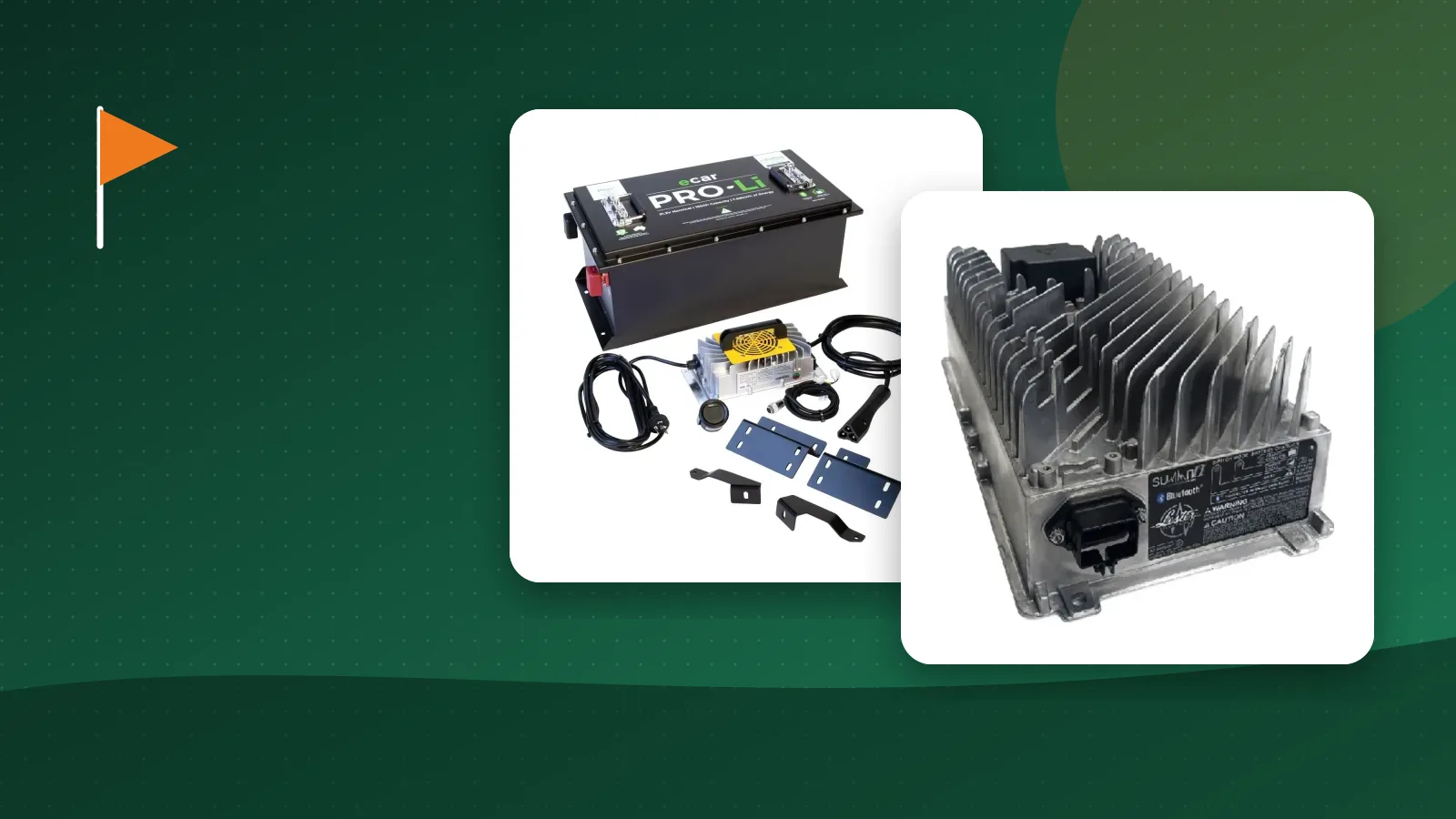
Swapping a tired lead-acid pack for lithium is one of the most popular upgrades for an older golf cart. The cart gets lighter, the maintenance chore of topping up water disappears and the power delivery stays steadier through the round. But lithium batteries for golf carts are not one-size-fits-all. Voltage, capacity, physical layout, connectors and the charger all need to match your cart. This guide explains how the packages we list differ, how to match one to your cart, what a lithium upgrade costs and what to ask before you buy.
Why owners move to lithium
A traditional golf cart runs on a bank of flooded lead-acid batteries, typically six 8V units or eight 6V units wired together to make 48V. They are heavy, they need regular watering and terminal cleaning, and they lose capacity as they age. A lithium package replaces that bank with a sealed, maintenance-free pack that is lighter than lead-acid. The pack listing for our PRO-Li range describes exactly that: sealed, maintenance-free lithium, lighter than lead-acid, matched to a specific cart and fitted by a qualified installer.
The practical benefits are easy to picture. There is no watering and no acid. The cart carries less weight, which can help acceleration and handling. Many owners find power feels steadier through the day instead of fading as the pack drains. For the chemistry and the trade-offs, read our guide to lithium versus lead-acid golf cart batteries, and for background on how lithium packs work see the lithium iron phosphate battery article on Wikipedia.
Core or Plus: 105Ah or 150Ah?
Our PRO-Li packages come in two capacities for 48V carts: the Core at 105Ah and the Plus at 150Ah. Multiplying voltage by amp-hours gives the stored energy in watt-hours, so a 48V 105Ah pack holds about 5,040Wh and a 48V 150Ah pack holds about 7,200Wh. That is simple arithmetic from the listed figures, not a range promise, because actual range depends on terrain, load, speed and tyre condition.
The Core suits owners who use the cart for short trips: around an estate, a short course or a small property. It costs less. The Plus suits those who drive further, carry more people or load, tackle hills or simply want more margin before recharging. Every package in the range is priced the same by capacity: the Core 105Ah packages are $3,625 including GST and the Plus 150Ah packages are $4,115.

Matching a package to your cart
Each package is matched to a specific cart. That matters because the battery tray, cable layout, controller and connectors differ between makes and models. We list packages for these carts:
- Club Car Precedent: Core 105Ah and Plus 150Ah.
- EZGO RXV: Core 105Ah and Plus 150Ah.
- Yamaha G22 and G19 (on-board and off-board versions) and G29: the G22 and G19 come in Core and Plus, and the G29 shares the Core package with the ECAR 627. One example is the G22 on-board Plus.
- ECAR 627, IKON and A-Series: for example the ECAR 627 Plus 150Ah and the ECAR IKON Core 105Ah.
Our lithium batteries page lists every package, and the brand pages for Club Car, EZGO, Yamaha and ECAR show carts we cover. If your cart is not listed, or you are not sure of the model year, contact us before you order. We will check fitment before payment, because the right match of voltage, capacity and connectors matters.
Smaller lithium batteries for buggies and trolleys
Not every lithium battery is for a ride-on cart. Golf buggies and electric trolleys use smaller batteries. We list the MGI Zip 24V 299Wh lithium battery at $538, the MGI Zip 24V 250Wh at $509, the MGI Ai GPS 24V 380Wh at $587, the MGI 12V 20Ah at $489 and the MGI 24V 13Ah at $567. Make sure the voltage and the series match your buggy, and see our guide to the 12V golf buggy battery if you are replacing a small 12V unit.
Do not forget the charger
A lithium pack needs a charger that suits it. Older lead-acid chargers may not charge a lithium pack correctly, and using the wrong charger can shorten battery life or create a hazard. Check what the package needs and whether your existing charger is compatible, and replace it if it is not. We list on-board and plug-in options, for example the Lester Summit II 48V on-board charger at $587, and the MGI 24V smart charger for Ai and Zip series at $166. Browse the chargers and conversion kits page for more, and never assume a charger is compatible without checking.
Installing a lithium package
Our listings say that lithium conversions should be fitted by a qualified person, and that you should keep photos of the installation for warranty. We agree with both. A golf cart battery bank carries a lot of current, so loose connections, undersized cables or incorrect wiring can cause heat or damage. A qualified installer will check the cart's controller and wiring, fit the pack securely, set up any required battery management or voltage reducer and test the cart. If you are not sure the cart's electrical system is in good condition, have it inspected as part of the installation.
Plan for weight distribution as well. A lithium pack is lighter than the lead-acid bank it replaces, and in some carts the battery weight helps with balance and traction. Ask your installer whether any ballast or mounting changes are needed.
How much does it cost?
The package price is only part of the cost. Add the installation labour, a new charger if the existing one is not suitable, freight and any small parts such as cables or mounting hardware. Compare that total with the cost of replacing a lead-acid set. For reference, a single Trojan T-105 6V 225Ah deep-cycle battery is $319, and a set of six Trojan T-875 8V batteries is $1,980. Lead-acid costs less up front, but you pay in weight, watering time and the likelihood of replacing the set sooner. Lithium costs more at the start and removes the watering routine. Which is better depends on how long you plan to keep the cart and how much you use it.
Looking after a lithium pack
Lithium packs ask for less attention, but not none. Charge with the correct charger in a dry, ventilated place, avoid deep discharge and avoid leaving the pack flat for long periods. If the cart will be stored for months, leave the pack partly charged and check it every few weeks. Keep terminals clean and tight and inspect wiring for damage. Never charge a damaged or swollen battery, and stop using any pack that smells or overheats. Recycle old lead-acid batteries and old packs at an approved collection point.
Should you upgrade, or replace the cart?
If the cart's frame, motor, controller and brakes are sound, a lithium package is a cost-effective way to refresh it. If the cart has other problems, such as a failing motor, rusted frame or worn suspension, check the whole repair bill before you spend $3,625 or more on batteries. At that point, a different cart may make better sense. Our used golf carts and electric golf carts pages show alternatives, and our guide to buying a used golf cart explains the checks.
Questions to ask before you buy
- Which cart make, model and year do I have?
- What voltage does the cart run, and does the package match?
- Do I need 105Ah or 150Ah for my use?
- Is my existing charger compatible, or do I need a new one?
- Who will install the pack, and what is included in the quote?
- What do I need to keep for warranty, such as installation photos and the invoice?
Common mistakes when upgrading
Most problems with a lithium upgrade come from a handful of avoidable mistakes. The first is buying on price alone, without checking that the package is matched to the cart. The second is reusing an old lead-acid charger without confirming that it suits a lithium pack. The third is skipping the installation photos, which you need for warranty. The fourth is ignoring the rest of the cart: worn cables, corroded terminals and a tired controller can limit the benefit of a new battery.
Avoid them by working in order. Confirm the cart make, model and year. Choose the package and capacity. Check the charger. Book a qualified installer and ask for a written quote. Take photos during installation and keep your invoice. If you are unsure at any step, send us the details and we will help before you pay.
Buying from Buggies For Sale
All prices are in Australian dollars including GST. We confirm stock, freight and fitment before you pay, and payment is by bank transfer (Osko or EFT), PayID or crypto, with 10% off automatically at checkout when you choose crypto. The minimum order is $250, freight is free over $1,000 to major metro and depot corridors and a flat $95 applies below that. Call +61420128746, message us on WhatsApp or email sales@buggiesforsale.com.au with your cart make, model and year, and we will help you choose the right package. You can also browse the full parts and accessories range.
Bottom line
Lithium batteries for golf carts remove the chore of watering, cut weight and give steadier power, but the right package depends on your cart, your use and your charger. Match voltage and fitment first, choose between 105Ah and 150Ah, budget for the charger and installation and keep your installation photos for warranty. When you are ready, send us your cart details and we will confirm what fits.


