How-to · 10 min read
Lithium Battery for Golf Buggy: Sizes, Prices and Replacement Guide
Need a lithium battery for golf buggy use? Learn how to match voltage and capacity, compare MGI packs from $489 and avoid common mistakes. Shop today.
By the Buggies For Sale team · Updated
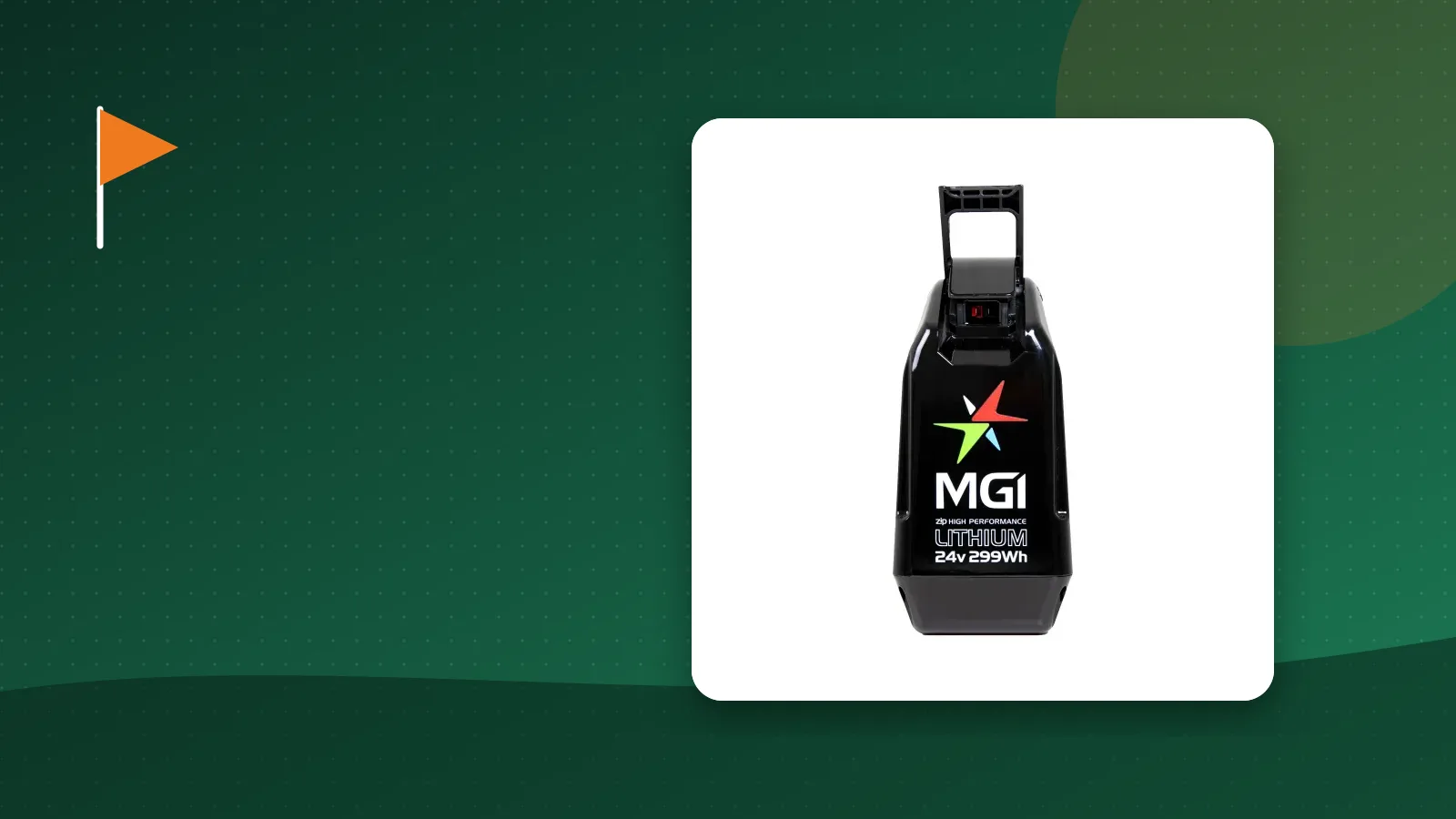
A lithium battery for a golf buggy is one of the best upgrades you can make, and also one of the easiest to get wrong. The battery has to match your buggy's voltage, fit the tray or connector and suit your charger. Buy the wrong one and it will not fit, will not charge properly or, at worst, could damage the buggy. This guide explains how to choose the right lithium battery for your golf buggy, what the numbers on the label mean, how long to expect a battery to last and how to look after it. It lists the batteries and chargers we stock, with prices and specifications as published.
Why lithium?
Most modern electric golf trolleys have moved to lithium because it is lighter, charges faster and needs less care than traditional lead-acid. A lighter battery makes the buggy easier to lift in and out of the boot, and it improves handling on the course. Lithium packs also hold their voltage better as they discharge, so the buggy keeps a steadier pace through the round. The chemistry and its variants are summarised in the lithium iron phosphate battery article on Wikipedia, and the older alternative is described in the lead-acid battery article. For a plain-English comparison, read our guide to lithium versus lead-acid golf cart batteries.
Reading the label: volts, amp-hours and watt-hours
Three numbers matter. Voltage (V) is the electrical pressure. Your buggy is designed for a particular voltage, usually 12V or 24V for trolleys, and the battery must match it. Amp-hours (Ah) measure how much charge the battery holds at that voltage. Watt-hours (Wh) measure total energy and are the clearest way to compare batteries: watt-hours equals volts multiplied by amp-hours. A 24V, 13Ah battery therefore holds about 312Wh. Bigger watt-hours means a longer round before you recharge, but also a heavier, more expensive pack.
Never choose a battery on capacity alone. The voltage must match, the connector must suit the buggy and the dimensions must fit. If you are not sure, ask us, and send the model name of your buggy.
MGI lithium batteries we stock
We stock a range of replacement batteries for MGI buggies, listed with the models they fit.
- MGI Zip 24V 250Wh Lithium Battery: $509, fits the MGI Zip series.
- MGI Zip 24V 299Wh Lithium Battery: $538, fits the MGI Zip series.
- MGI Ai GPS 24V 380Wh Lithium Battery: $587, fits the MGI Ai series.
- MGI Lithium 24V 13Ah Battery: $567, listed as fitting MGI buggies.
- MGI Lithium 12V 20Ah Battery: $489, listed as fitting MGI buggies.
- MGI Lithium 12V 299Wh Battery: $538, listed as fitting MGI buggies.

The pattern is clear: the 12V models are for buggies that run on 12V, the 24V models for 24V buggies, and the Zip and Ai batteries are matched to those families. Compare these with the buggy you own on our MGI brand page, and see the full lithium batteries category for everything else.
Don't forget the charger
A lithium battery should be charged with a charger designed for it. The MGI Lithium 24V Smart Charger for Ai and Zip Series is $166. We also list the MGI Fireproof Charging Box at $142 for people who want a safer place to charge. Do not use a charger from another device, even if the plug fits. Check our chargers and conversion kits category for other options.
Larger lithium batteries for golf carts
If you have a full-size golf cart rather than a trolley, the scale changes. We stock the PRO-Li packages for 48V carts, for example the PRO-Li Core 48V 105Ah package for Club Car Precedent at $3,625 and the PRO-Li Plus 48V 150Ah package at $4,115, with matching versions for EZGO, Yamaha and ECAR models. Our guide to lithium batteries for golf carts covers those in detail.
How long does a golf buggy battery last?
Battery life depends on use, charging habits and storage. In general, lithium batteries last more charge cycles than lead-acid, and they lose capacity gradually. Heat is the enemy: leaving a battery in a hot car shortens its life. Deep discharge, where you run the battery flat repeatedly, also reduces life. We cannot promise a specific number of years, because it varies by owner. Ask the manufacturer for the warranty terms listed for each product.
How to look after a lithium battery
- Charge after each round. A battery left flat for weeks can lose capacity.
- Use the right charger. Never substitute.
- Store it cool and dry. Avoid hot boots, direct sun and damp garages.
- Do not charge a damaged battery. If the case is cracked, swollen or hot, stop using it.
- Do not leave it charging unattended for long periods on a flammable surface.
- Keep terminals clean and check the connector for wear.
Replacement or upgrade?
If your battery no longer lasts a round, you can either replace it with the same type or upgrade to a larger one, provided it fits your buggy and connector. A bigger battery adds range but also weight, so check the spec. If you are weighing up a new buggy against a new battery, read our golf buggy size guide, and our 12V golf buggy battery guide if yours is a 12V model. For a lithium powered trolley, see the PowerBug NX at $862 or Thomson E5000 Pro at $636.
How to size a replacement battery
Start by finding the label on your current battery. It usually shows voltage and capacity. If the label is worn, check your buggy's manual or the product page for the model. Write down the voltage, the capacity, the connector type and the physical size of the tray. Then compare those with the replacement. A battery with the same voltage and a slightly higher capacity is usually a good upgrade, provided it fits. A battery with a different voltage should never be used unless the manufacturer says the buggy supports it. If you are not sure, send us a photo of the label and the buggy model, and we will help you check.
Signs your battery needs replacing
A tired battery shows itself in a few ways. The buggy runs for fewer holes than it used to, or the speed drops towards the end of the round. The battery takes longer to charge, or the charger never shows a full charge. The case feels unusually hot when charging, or it looks swollen or damaged. If you see swelling, stop using the battery and do not charge it. Contact the seller or the manufacturer for advice, and dispose of old lithium batteries through a proper recycling point rather than the household bin.
Transporting and storing batteries
Lithium batteries are safe when handled properly, but they deserve care. Carry the battery in its case and never drop it. In a car, keep it away from direct sun and do not leave it in a hot boot. For flights and some transport, lithium batteries are subject to rules, so check with the carrier before you travel with a spare. For storage over the off-season, charge the battery partially, rather than fully or flat, store it in a cool, dry place and check it every few weeks. Follow the maker's storage advice, which is the best guide for your specific pack.
What about conversion kits?
Some owners of older buggies and carts look at lithium conversion kits that replace lead-acid batteries. These can work well but the details matter: the charger, the controller and the battery management must all be compatible. Our chargers and conversion kits category lists what we stock, and we recommend asking before you order so you get a combination that works together.
Frequently overlooked details
Check the connector type, the cable length and whether the battery comes with a carry case or mounting strap. Make sure the new battery will sit securely in the tray, because a loose battery can damage connectors. Keep the old battery until the new one is working, and dispose of it through a proper recycling point. These small details separate a smooth swap from a frustrating one.
Buying a lithium battery from us
All prices are in Australian dollars and include GST. We confirm stock and freight to your postcode before you pay, and the $250 minimum order applies, so a battery and charger together often make sense. You can pay by bank transfer (Osko or EFT), PayID or crypto, with a 10% discount applied automatically when you choose crypto at checkout. Orders over $1,000 ship free to major metro and depot corridors, and a flat $95 freight charge applies below that. Call +61420128746 or message us with your buggy model and we will help you check compatibility before you order.
Bottom line
The right lithium battery for a golf buggy matches your buggy's voltage, connector and fitment, and comes with a proper charger. Choose by watt-hours for range, then check the fit. Our MGI range runs from $489 to $587, and the matching smart charger is $166. If in doubt, ask before you buy.


